Real Estate Repositioning in Cambodia for Long-Term Asset Value
Real Estate Repositioning in Cambodia for Long-Term Asset Value

Cambodia's real estate market is entering a more competitive phase. Residential, commercial, hospitality and mixed-use developments continue to expand, giving occupiers more choice and raising expectations of how buildings should perform throughout their lifecycle.
Commercial performance is increasingly shaped by more than location, timing or the delivery of a new building. Leasing resilience, operational efficiency, environmental performance and the ability to respond to changing market needs are becoming stronger indicators of long-term asset value.
This transition is not unique to Cambodia. As markets mature, successful developments distinguish themselves through a clear market position, efficient operations and an understanding of how buildings continue to create value after completion. These shifts are becoming an essential part of development strategy, particularly as occupier priorities evolve across Cambodia's property market.
Key takeaways
Location remains important, but long-term competitiveness depends on building performance, operational efficiency and market relevance.
Real estate repositioning helps existing assets respond to changing occupier expectations, ESG standards and commercial objectives.
High-impact interventions such as façade upgrades, public realm activation and operational planning can improve asset value before major redevelopment is considered.
Adaptive reuse and strategic repositioning can, in some cases, create stronger commercial outcomes than full redevelopment.
Stronger asset performance comes from aligning market demand, operational needs and the built environment.
Why location alone no longer guarantees competitiveness
Location still influences accessibility, visibility and market demand. It remains one of the most valuable fundamentals in real estate development.

Competitive advantage in maturing markets is increasingly determined by how buildings operate, not where they stand. Photo by Nara Tsitra via Pexels.
Assets within the same district, however, can produce very different commercial outcomes. The gap increasingly comes from how effectively each building supports occupiers, adapts to operational requirements and responds to evolving market expectations.
Office occupiers assess more than address and floorplate. Workplace decisions increasingly affect talent attraction, organizational efficiency and employee wellbeing. Residential buyers place greater emphasis on convenience, community and long-term livability. Retail developments compete through footfall, dwell time and repeat visitation. Hospitality operators continue to differentiate through experience, positioning, and operational clarity, particularly in competitive markets.
Research indicates that travelers increasingly prioritize distinctive and meaningful experiences over price, showing how value becomes more closely linked to relevance than cost (McKinsey & Company, 2024). The same commercial logic is increasingly visible across property sectors in Cambodia.
How real estate repositioning creates long-term asset value
Real estate repositioning is a strategic assessment of whether an asset continues to meet market demand while supporting commercial objectives.
Buildings can remain structurally sound while becoming less competitive in the market they serve. Business models evolve. Occupier priorities change. Environmental standards develop. New supply raises the benchmark for performance. Under these conditions, an asset's long-term value depends on its ability to stay relevant.
"Commercial performance begins with building performance."
Strategic repositioning evaluates where value can be strengthened within an existing asset. This may involve improving operational efficiency, updating the tenant offer, refining the public interface, rethinking circulation, or aligning the building more closely with current market demand.
This approach is increasingly relevant across Cambodia's commercial property market as international brands, institutional investors and more sophisticated occupiers raise expectations of how assets should perform.
Building performance shapes commercial performance
Building performance directly influences commercial performance.
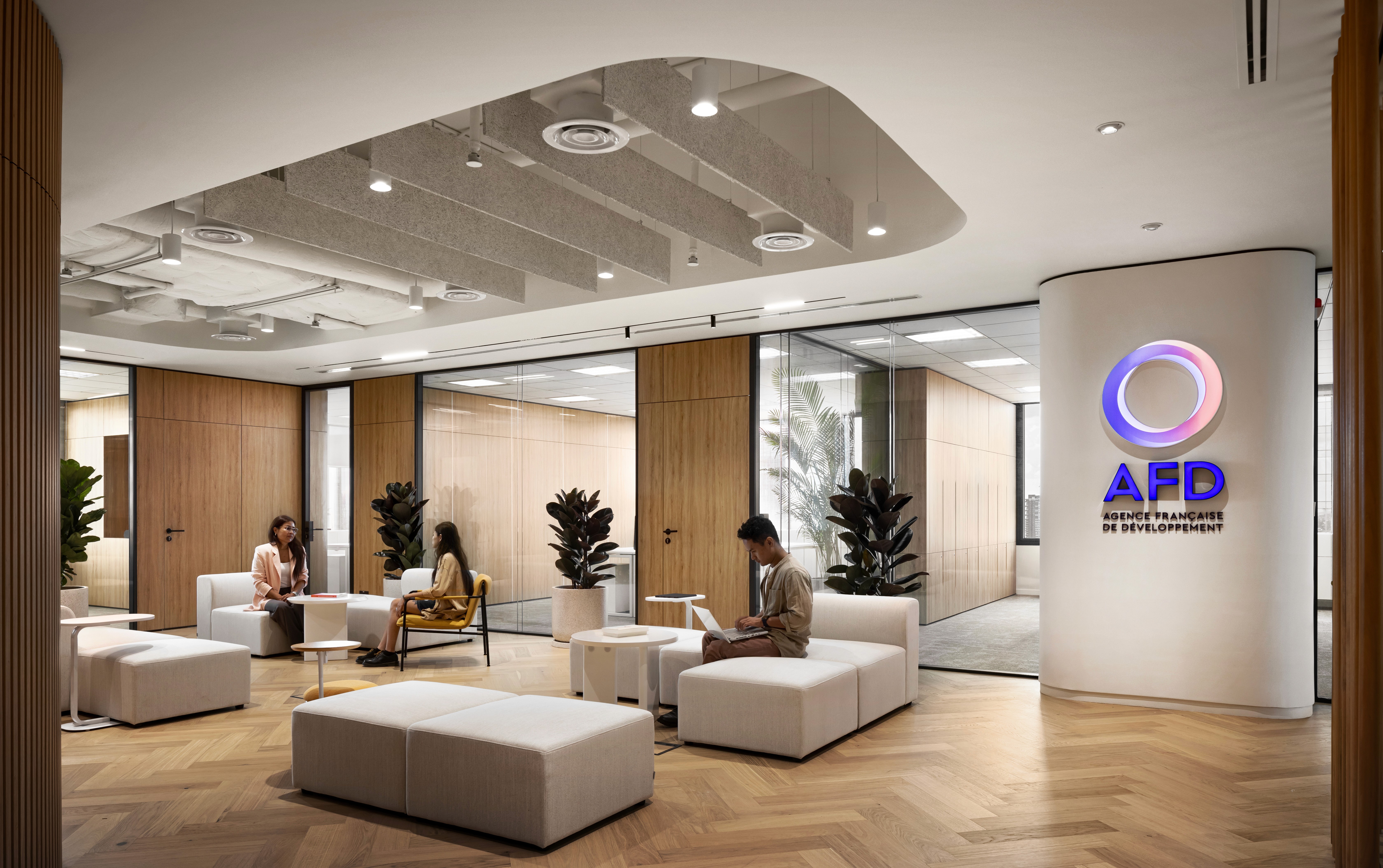
Workplace design around occupant wellbeing and operational logic. AFD Cambodia Office, Phnom Penh. Interior design by The Room Architecture and Design.
A workplace that supports efficient collaboration can improve organizational productivity and strengthen tenant retention. Residential developments that prioritize convenience and amenity can support longer occupancy and stronger market appeal. Retail environments that improve circulation, visibility, and public realm can strengthen tenant trading conditions. Hospitality environments that support a clear guest proposition can improve pricing power and brand loyalty, particularly as Cambodia's hospitality market evolves.
Visible upgrades such as refreshed façades, upgraded lobbies and new branding may improve perception, but their long-term value depends on deeper performance factors. Day-to-day efficiency, environmental responsiveness, accessibility, circulation, and operational logic all contribute to how an asset is experienced and how it performs commercially.
This is where repositioning becomes commercially meaningful. It links design and operational decisions to leasing resilience, asset value and long-term market relevance.
High-impact repositioning interventions before major redevelopment

How a building presents itself to the market is also how it performs in it. Photo of Tribe Phnom Penh by Phanoth DYNA on Unsplash.
Major redevelopment is not always the most effective route to improving asset value. Many existing assets contain unrealized potential that can be unlocked through targeted interventions with lower capital expenditure and less disruption to ongoing operations.
High-impact interventions may include:
improving façade performance to reduce heat gain, improve energy efficiency, and lower operational costs
activating public realm to increase footfall, strengthen surrounding environments, and support tenant performance
reconfiguring circulation to improve accessibility, servicing, and day-to-day efficiency
introducing more flexible workplace, retail, or mixed-use environments that respond to changing occupier requirements
optimizing shared amenities to strengthen leasing competitiveness and long-term asset performance
refining operational planning to support maintenance, security, arrivals, and back-of-house efficiency
These interventions are valuable because they improve how the asset functions, not simply how it appears.
ESG and building performance in Cambodia's commercial real estate market
Environmental, Social and Governance (ESG) expectations are becoming more influential across commercial real estate.
Institutional investors, multinational occupiers, and lenders place increasing emphasis on operational efficiency, energy performance, occupant wellbeing, and long-term resilience. Asset performance is now evaluated through a broader set of measures that extend beyond financial return alone.
This has clear implications for existing buildings in Cambodia. Improving environmental performance, extending asset life, and creating healthier internal environments can strengthen commercial outcomes while reducing the financial and environmental costs associated with unnecessary redevelopment.
As Cambodia continues to attract international investment and institutional-grade developments, ESG expectations are likely to become a more prominent benchmark for asset performance across office, hospitality, retail and mixed-use assets.
Repositioning vs redevelopment vs adaptive reuse
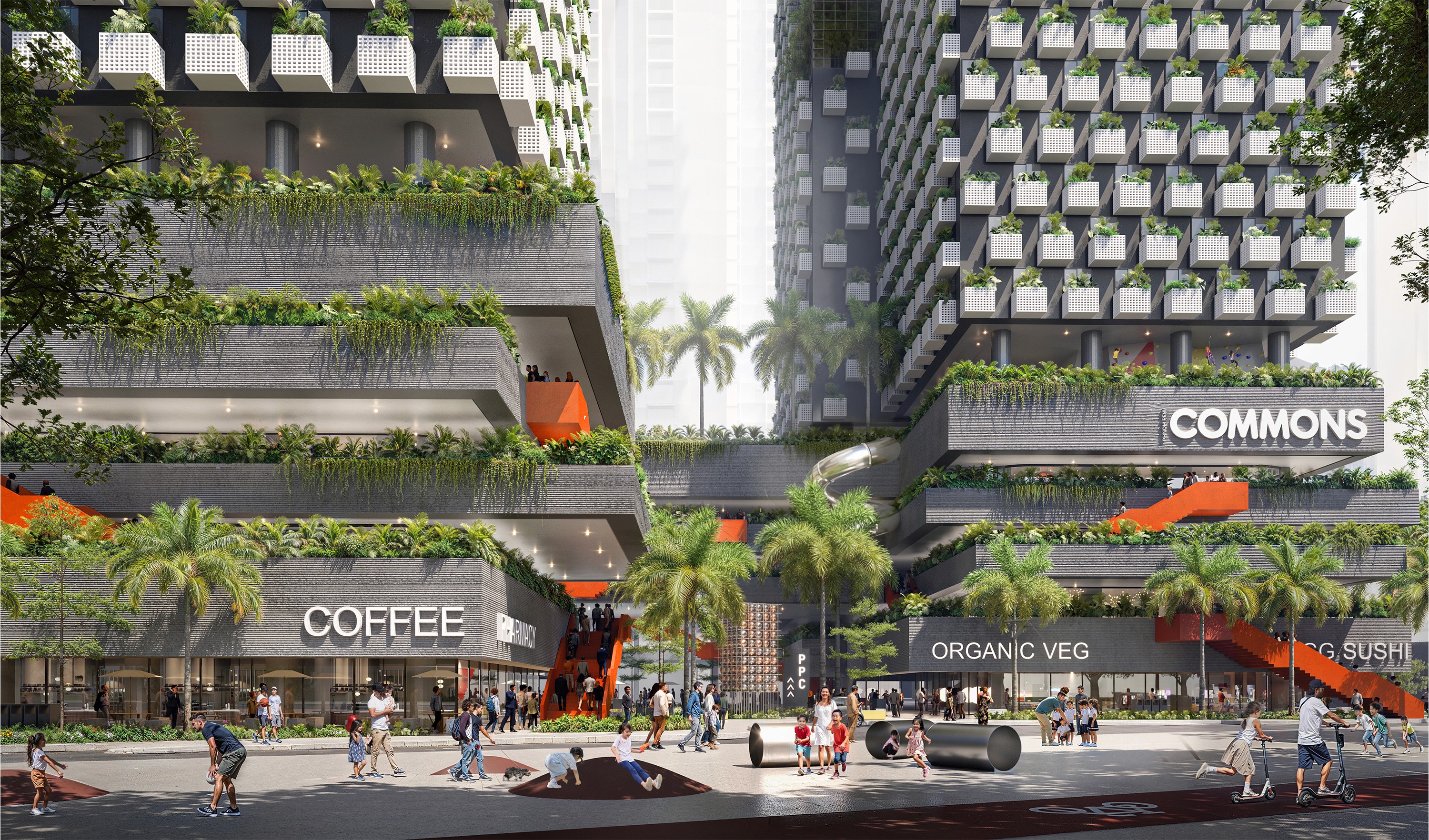
Ground-floor activation, public realm and mixed-use programming designed around occupier experience and commercial performance. Phnom Penh Commons, concept project by The Room Architecture and Design.
Redevelopment remains appropriate for some assets. Other buildings contain significant unrealized value that can be captured through strategic repositioning or adaptive reuse.
The right decision depends on understanding where performance constraints originate. In some cases, the issue lies in outdated layouts, inefficient building systems, underused public spaces or an offer that no longer aligns with market demand. These constraints can affect leasing performance and long-term asset value without requiring complete reconstruction.
A clear strategic assessment helps determine where capital can create the strongest commercial return. Repositioning may improve competitiveness through targeted upgrades. Adaptive reuse may open a new market opportunity. Full redevelopment may be justified where structural, operational or market constraints are too significant to resolve within the existing asset.
Each option should be evaluated through the same lens: commercial performance, operational efficiency, market relevance and long-term asset value.
How to evaluate existing assets for long-term value
Every asset represents an ongoing investment decision.
Maintaining long-term value requires periodic evaluation of how a building performs operationally, commercially, and environmentally before major capital investment is committed. That evaluation should consider:
current market position
occupier expectations
operational inefficiencies
building performance
ESG requirements
leasing resilience
opportunities for targeted intervention
Strategic repositioning provides a framework for identifying improvements that extend the commercial life of an asset and strengthen its value in a more competitive market.
"Every building reaches completion. Asset performance continues to evolve."
If you have an asset or project under consideration, share your project details with The Room Architecture and Design. We can help assess where targeted design, operational improvements, or a broader repositioning strategy may strengthen commercial performance, user wellbeing, and long-term asset value.
Cambodia's real estate market is entering a more competitive phase. Residential, commercial, hospitality and mixed-use developments continue to expand, giving occupiers more choice and raising expectations of how buildings should perform throughout their lifecycle.
Commercial performance is increasingly shaped by more than location, timing or the delivery of a new building. Leasing resilience, operational efficiency, environmental performance and the ability to respond to changing market needs are becoming stronger indicators of long-term asset value.
This transition is not unique to Cambodia. As markets mature, successful developments distinguish themselves through a clear market position, efficient operations and an understanding of how buildings continue to create value after completion. These shifts are becoming an essential part of development strategy, particularly as occupier priorities evolve across Cambodia's property market.
Key takeaways
Location remains important, but long-term competitiveness depends on building performance, operational efficiency and market relevance.
Real estate repositioning helps existing assets respond to changing occupier expectations, ESG standards and commercial objectives.
High-impact interventions such as façade upgrades, public realm activation and operational planning can improve asset value before major redevelopment is considered.
Adaptive reuse and strategic repositioning can, in some cases, create stronger commercial outcomes than full redevelopment.
Stronger asset performance comes from aligning market demand, operational needs and the built environment.
Why location alone no longer guarantees competitiveness
Location still influences accessibility, visibility and market demand. It remains one of the most valuable fundamentals in real estate development.
Competitive advantage in maturing markets is increasingly determined by how buildings operate, not where they stand. Photo by Nara Tsitra via Pexels.
Assets within the same district, however, can produce very different commercial outcomes. The gap increasingly comes from how effectively each building supports occupiers, adapts to operational requirements and responds to evolving market expectations.
Office occupiers assess more than address and floorplate. Workplace decisions increasingly affect talent attraction, organizational efficiency and employee wellbeing. Residential buyers place greater emphasis on convenience, community and long-term livability. Retail developments compete through footfall, dwell time and repeat visitation. Hospitality operators continue to differentiate through experience, positioning, and operational clarity, particularly in competitive markets.
Research indicates that travelers increasingly prioritize distinctive and meaningful experiences over price, showing how value becomes more closely linked to relevance than cost (McKinsey & Company, 2024). The same commercial logic is increasingly visible across property sectors in Cambodia.
How real estate repositioning creates long-term asset value
Real estate repositioning is a strategic assessment of whether an asset continues to meet market demand while supporting commercial objectives.
Buildings can remain structurally sound while becoming less competitive in the market they serve. Business models evolve. Occupier priorities change. Environmental standards develop. New supply raises the benchmark for performance. Under these conditions, an asset's long-term value depends on its ability to stay relevant.
"Commercial performance begins with building performance."
Strategic repositioning evaluates where value can be strengthened within an existing asset. This may involve improving operational efficiency, updating the tenant offer, refining the public interface, rethinking circulation, or aligning the building more closely with current market demand.
This approach is increasingly relevant across Cambodia's commercial property market as international brands, institutional investors and more sophisticated occupiers raise expectations of how assets should perform.
Building performance shapes commercial performance
Building performance directly influences commercial performance.
Workplace design around occupant wellbeing and operational logic. AFD Cambodia Office, Phnom Penh. Interior design by The Room Architecture and Design.
A workplace that supports efficient collaboration can improve organizational productivity and strengthen tenant retention. Residential developments that prioritize convenience and amenity can support longer occupancy and stronger market appeal. Retail environments that improve circulation, visibility, and public realm can strengthen tenant trading conditions. Hospitality environments that support a clear guest proposition can improve pricing power and brand loyalty, particularly as Cambodia's hospitality market evolves.
Visible upgrades such as refreshed façades, upgraded lobbies and new branding may improve perception, but their long-term value depends on deeper performance factors. Day-to-day efficiency, environmental responsiveness, accessibility, circulation, and operational logic all contribute to how an asset is experienced and how it performs commercially.
This is where repositioning becomes commercially meaningful. It links design and operational decisions to leasing resilience, asset value and long-term market relevance.
High-impact repositioning interventions before major redevelopment
How a building presents itself to the market is also how it performs in it. Photo of Tribe Phnom Penh by Phanoth DYNA on Unsplash.
Major redevelopment is not always the most effective route to improving asset value. Many existing assets contain unrealized potential that can be unlocked through targeted interventions with lower capital expenditure and less disruption to ongoing operations.
High-impact interventions may include:
improving façade performance to reduce heat gain, improve energy efficiency, and lower operational costs
activating public realm to increase footfall, strengthen surrounding environments, and support tenant performance
reconfiguring circulation to improve accessibility, servicing, and day-to-day efficiency
introducing more flexible workplace, retail, or mixed-use environments that respond to changing occupier requirements
optimizing shared amenities to strengthen leasing competitiveness and long-term asset performance
refining operational planning to support maintenance, security, arrivals, and back-of-house efficiency
These interventions are valuable because they improve how the asset functions, not simply how it appears.
ESG and building performance in Cambodia's commercial real estate market
Environmental, Social and Governance (ESG) expectations are becoming more influential across commercial real estate.
Institutional investors, multinational occupiers, and lenders place increasing emphasis on operational efficiency, energy performance, occupant wellbeing, and long-term resilience. Asset performance is now evaluated through a broader set of measures that extend beyond financial return alone.
This has clear implications for existing buildings in Cambodia. Improving environmental performance, extending asset life, and creating healthier internal environments can strengthen commercial outcomes while reducing the financial and environmental costs associated with unnecessary redevelopment.
As Cambodia continues to attract international investment and institutional-grade developments, ESG expectations are likely to become a more prominent benchmark for asset performance across office, hospitality, retail and mixed-use assets.
Repositioning vs redevelopment vs adaptive reuse
Ground-floor activation, public realm and mixed-use programming designed around occupier experience and commercial performance. Phnom Penh Commons, concept project by The Room Architecture and Design.
Redevelopment remains appropriate for some assets. Other buildings contain significant unrealized value that can be captured through strategic repositioning or adaptive reuse.
The right decision depends on understanding where performance constraints originate. In some cases, the issue lies in outdated layouts, inefficient building systems, underused public spaces or an offer that no longer aligns with market demand. These constraints can affect leasing performance and long-term asset value without requiring complete reconstruction.
A clear strategic assessment helps determine where capital can create the strongest commercial return. Repositioning may improve competitiveness through targeted upgrades. Adaptive reuse may open a new market opportunity. Full redevelopment may be justified where structural, operational or market constraints are too significant to resolve within the existing asset.
Each option should be evaluated through the same lens: commercial performance, operational efficiency, market relevance and long-term asset value.
How to evaluate existing assets for long-term value
Every asset represents an ongoing investment decision.
Maintaining long-term value requires periodic evaluation of how a building performs operationally, commercially, and environmentally before major capital investment is committed. That evaluation should consider:
current market position
occupier expectations
operational inefficiencies
building performance
ESG requirements
leasing resilience
opportunities for targeted intervention
Strategic repositioning provides a framework for identifying improvements that extend the commercial life of an asset and strengthen its value in a more competitive market.
"Every building reaches completion. Asset performance continues to evolve."
If you have an asset or project under consideration, share your project details with The Room Architecture and Design. We can help assess where targeted design, operational improvements, or a broader repositioning strategy may strengthen commercial performance, user wellbeing, and long-term asset value.
Cambodia's real estate market is entering a more competitive phase. Residential, commercial, hospitality and mixed-use developments continue to expand, giving occupiers more choice and raising expectations of how buildings should perform throughout their lifecycle.
Commercial performance is increasingly shaped by more than location, timing or the delivery of a new building. Leasing resilience, operational efficiency, environmental performance and the ability to respond to changing market needs are becoming stronger indicators of long-term asset value.
This transition is not unique to Cambodia. As markets mature, successful developments distinguish themselves through a clear market position, efficient operations and an understanding of how buildings continue to create value after completion. These shifts are becoming an essential part of development strategy, particularly as occupier priorities evolve across Cambodia's property market.
Key takeaways
Location remains important, but long-term competitiveness depends on building performance, operational efficiency and market relevance.
Real estate repositioning helps existing assets respond to changing occupier expectations, ESG standards and commercial objectives.
High-impact interventions such as façade upgrades, public realm activation and operational planning can improve asset value before major redevelopment is considered.
Adaptive reuse and strategic repositioning can, in some cases, create stronger commercial outcomes than full redevelopment.
Stronger asset performance comes from aligning market demand, operational needs and the built environment.
Why location alone no longer guarantees competitiveness
Location still influences accessibility, visibility and market demand. It remains one of the most valuable fundamentals in real estate development.
Competitive advantage in maturing markets is increasingly determined by how buildings operate, not where they stand. Photo by Nara Tsitra via Pexels.
Assets within the same district, however, can produce very different commercial outcomes. The gap increasingly comes from how effectively each building supports occupiers, adapts to operational requirements and responds to evolving market expectations.
Office occupiers assess more than address and floorplate. Workplace decisions increasingly affect talent attraction, organizational efficiency and employee wellbeing. Residential buyers place greater emphasis on convenience, community and long-term livability. Retail developments compete through footfall, dwell time and repeat visitation. Hospitality operators continue to differentiate through experience, positioning, and operational clarity, particularly in competitive markets.
Research indicates that travelers increasingly prioritize distinctive and meaningful experiences over price, showing how value becomes more closely linked to relevance than cost (McKinsey & Company, 2024). The same commercial logic is increasingly visible across property sectors in Cambodia.
How real estate repositioning creates long-term asset value
Real estate repositioning is a strategic assessment of whether an asset continues to meet market demand while supporting commercial objectives.
Buildings can remain structurally sound while becoming less competitive in the market they serve. Business models evolve. Occupier priorities change. Environmental standards develop. New supply raises the benchmark for performance. Under these conditions, an asset's long-term value depends on its ability to stay relevant.
"Commercial performance begins with building performance."
Strategic repositioning evaluates where value can be strengthened within an existing asset. This may involve improving operational efficiency, updating the tenant offer, refining the public interface, rethinking circulation, or aligning the building more closely with current market demand.
This approach is increasingly relevant across Cambodia's commercial property market as international brands, institutional investors and more sophisticated occupiers raise expectations of how assets should perform.
Building performance shapes commercial performance
Building performance directly influences commercial performance.
Workplace design around occupant wellbeing and operational logic. AFD Cambodia Office, Phnom Penh. Interior design by The Room Architecture and Design.
A workplace that supports efficient collaboration can improve organizational productivity and strengthen tenant retention. Residential developments that prioritize convenience and amenity can support longer occupancy and stronger market appeal. Retail environments that improve circulation, visibility, and public realm can strengthen tenant trading conditions. Hospitality environments that support a clear guest proposition can improve pricing power and brand loyalty, particularly as Cambodia's hospitality market evolves.
Visible upgrades such as refreshed façades, upgraded lobbies and new branding may improve perception, but their long-term value depends on deeper performance factors. Day-to-day efficiency, environmental responsiveness, accessibility, circulation, and operational logic all contribute to how an asset is experienced and how it performs commercially.
This is where repositioning becomes commercially meaningful. It links design and operational decisions to leasing resilience, asset value and long-term market relevance.
High-impact repositioning interventions before major redevelopment
How a building presents itself to the market is also how it performs in it. Photo of Tribe Phnom Penh by Phanoth DYNA on Unsplash.
Major redevelopment is not always the most effective route to improving asset value. Many existing assets contain unrealized potential that can be unlocked through targeted interventions with lower capital expenditure and less disruption to ongoing operations.
High-impact interventions may include:
improving façade performance to reduce heat gain, improve energy efficiency, and lower operational costs
activating public realm to increase footfall, strengthen surrounding environments, and support tenant performance
reconfiguring circulation to improve accessibility, servicing, and day-to-day efficiency
introducing more flexible workplace, retail, or mixed-use environments that respond to changing occupier requirements
optimizing shared amenities to strengthen leasing competitiveness and long-term asset performance
refining operational planning to support maintenance, security, arrivals, and back-of-house efficiency
These interventions are valuable because they improve how the asset functions, not simply how it appears.
ESG and building performance in Cambodia's commercial real estate market
Environmental, Social and Governance (ESG) expectations are becoming more influential across commercial real estate.
Institutional investors, multinational occupiers, and lenders place increasing emphasis on operational efficiency, energy performance, occupant wellbeing, and long-term resilience. Asset performance is now evaluated through a broader set of measures that extend beyond financial return alone.
This has clear implications for existing buildings in Cambodia. Improving environmental performance, extending asset life, and creating healthier internal environments can strengthen commercial outcomes while reducing the financial and environmental costs associated with unnecessary redevelopment.
As Cambodia continues to attract international investment and institutional-grade developments, ESG expectations are likely to become a more prominent benchmark for asset performance across office, hospitality, retail and mixed-use assets.
Repositioning vs redevelopment vs adaptive reuse
Ground-floor activation, public realm and mixed-use programming designed around occupier experience and commercial performance. Phnom Penh Commons, concept project by The Room Architecture and Design.
Redevelopment remains appropriate for some assets. Other buildings contain significant unrealized value that can be captured through strategic repositioning or adaptive reuse.
The right decision depends on understanding where performance constraints originate. In some cases, the issue lies in outdated layouts, inefficient building systems, underused public spaces or an offer that no longer aligns with market demand. These constraints can affect leasing performance and long-term asset value without requiring complete reconstruction.
A clear strategic assessment helps determine where capital can create the strongest commercial return. Repositioning may improve competitiveness through targeted upgrades. Adaptive reuse may open a new market opportunity. Full redevelopment may be justified where structural, operational or market constraints are too significant to resolve within the existing asset.
Each option should be evaluated through the same lens: commercial performance, operational efficiency, market relevance and long-term asset value.
How to evaluate existing assets for long-term value
Every asset represents an ongoing investment decision.
Maintaining long-term value requires periodic evaluation of how a building performs operationally, commercially, and environmentally before major capital investment is committed. That evaluation should consider:
current market position
occupier expectations
operational inefficiencies
building performance
ESG requirements
leasing resilience
opportunities for targeted intervention
Strategic repositioning provides a framework for identifying improvements that extend the commercial life of an asset and strengthen its value in a more competitive market.
"Every building reaches completion. Asset performance continues to evolve."
If you have an asset or project under consideration, share your project details with The Room Architecture and Design. We can help assess where targeted design, operational improvements, or a broader repositioning strategy may strengthen commercial performance, user wellbeing, and long-term asset value.