Malis at Techo International Airport and the Role of Design
Malis at Techo International Airport and the Role of Design
Airports shape first impressions. They are not only transit environments, they are also public-facing spaces where a country’s identity, service standards, and design priorities become visible at scale. Techo International Airport in Phnom Penh places this question in a Cambodian context, where hospitality must operate under the conditions of a fast-moving international terminal while still reflecting local culture.
Malis Restaurant responds to that brief through a design that balances cultural narrative with operational precision. It is not treated as a standalone dining room, but as part of the broader passenger experience at one of Cambodia’s most significant new gateways. The project shows how hospitality design can support function, brand clarity, and national identity at the same time.
Malis as a Cambodian hospitality brand in transit
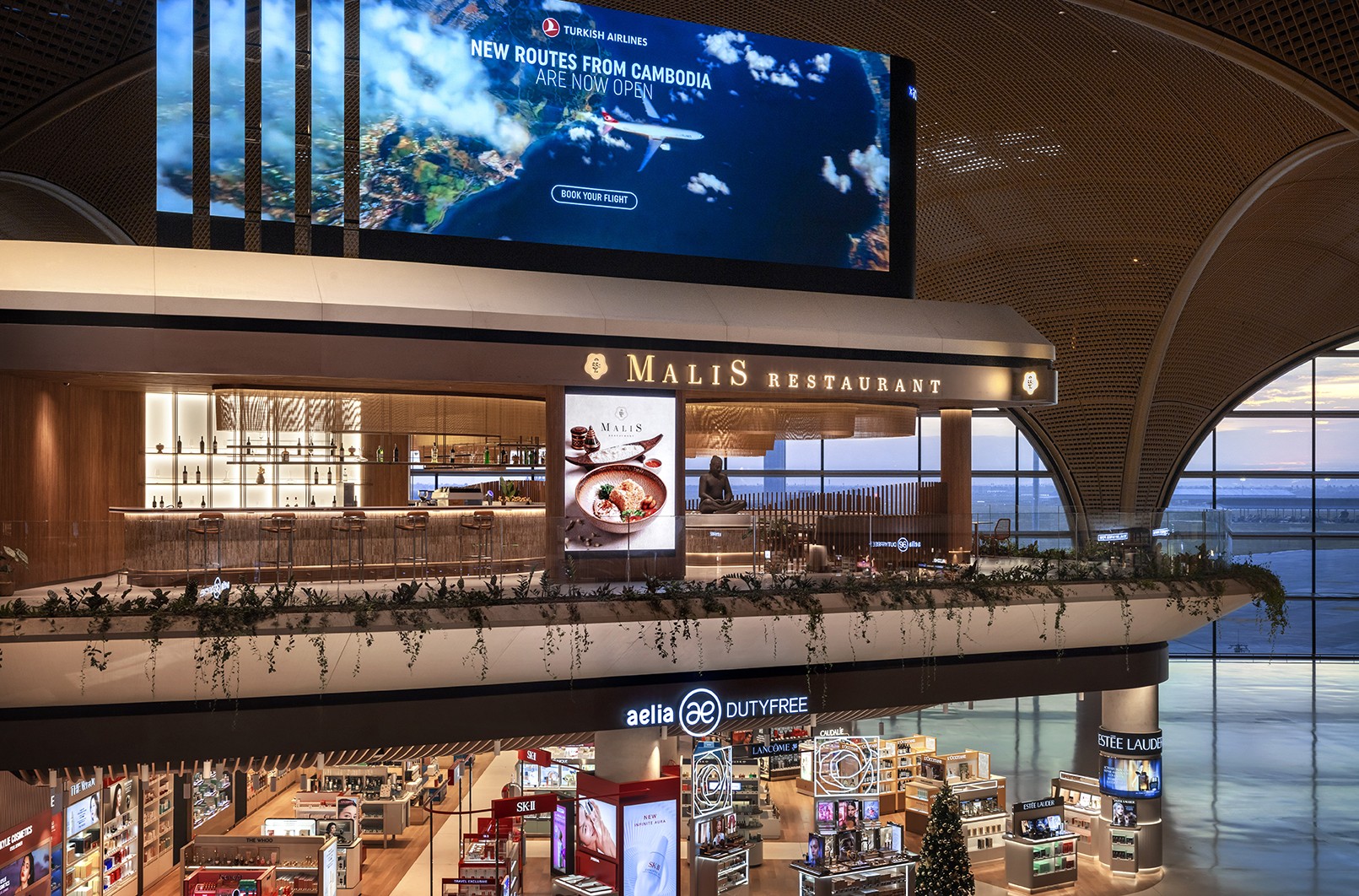
The entrance to Malis Restaurant at Techo International Airport, where timber detailing and branded signage define the arrival sequence.
Malis carries a strong brand position as a Phnom Penh heritage restaurant operated by Thalias Hospitality Group, known for Living Cambodian Cuisine. At Techo International Airport, that identity needed to translate into a setting shaped by security, passenger flow, and short dwell times.
The 346.8 m² floorplate accommodates 92 guests across banquette seating, private tables, bar counters, and a terrace. The layout is divided with clear intent, separating front of house, bar, and kitchen functions so that staff movement, service delivery, and guest circulation can operate without conflict. In an airport environment, that level of planning is essential. It supports both service speed and consistency, while preserving a clear guest experience.
Calm as a design strategy
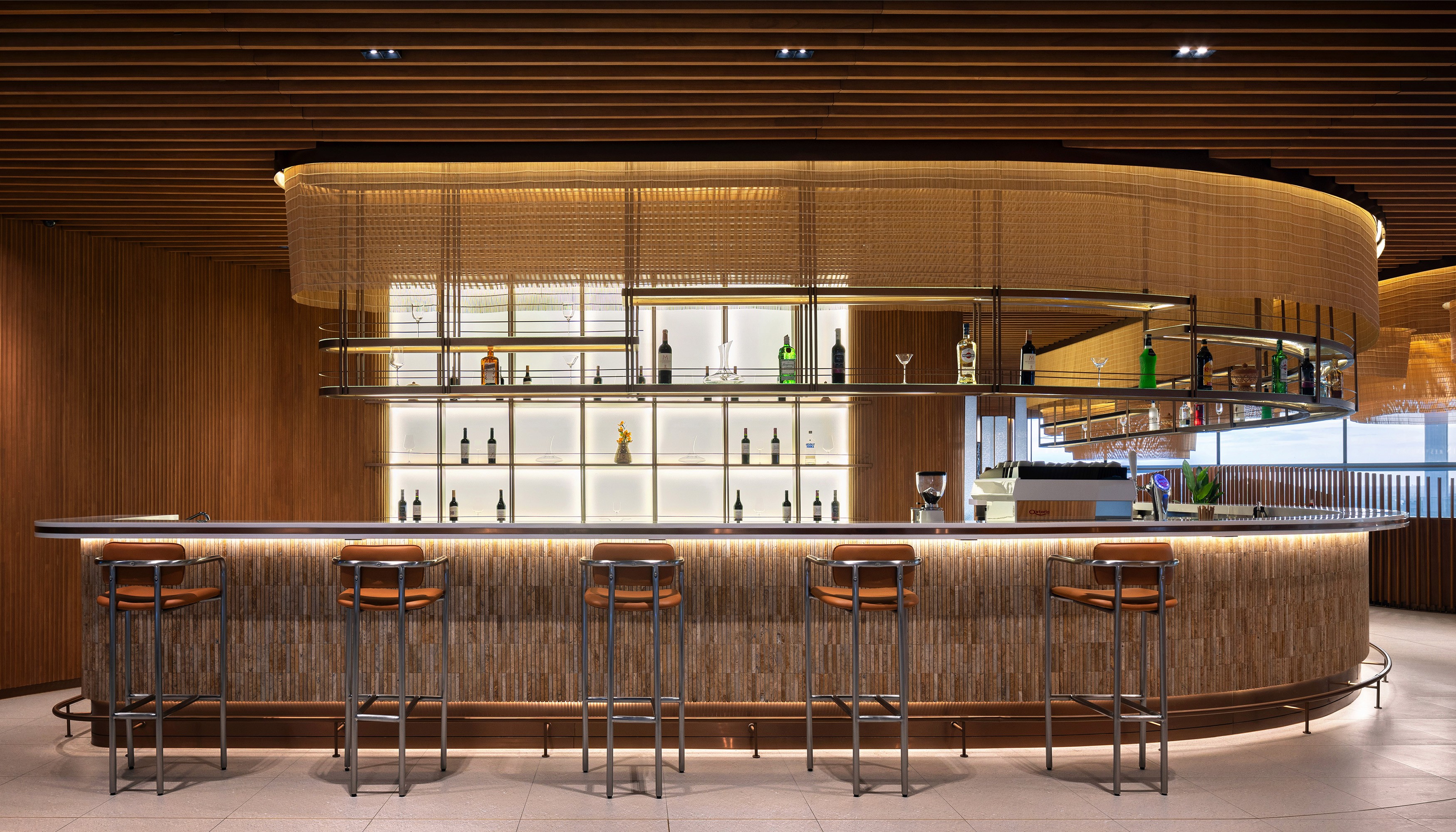
A circular backlit bar at Malis Restaurant, Techo International Airport, designed to support efficient airport hospitality in Phnom Penh.
One of the most relevant ideas in airport hospitality is calm. In terminals defined by noise, movement, and time pressure, spaces that reduce visual and sensory load become valuable. Malis uses this principle without resorting to theatrical gestures.
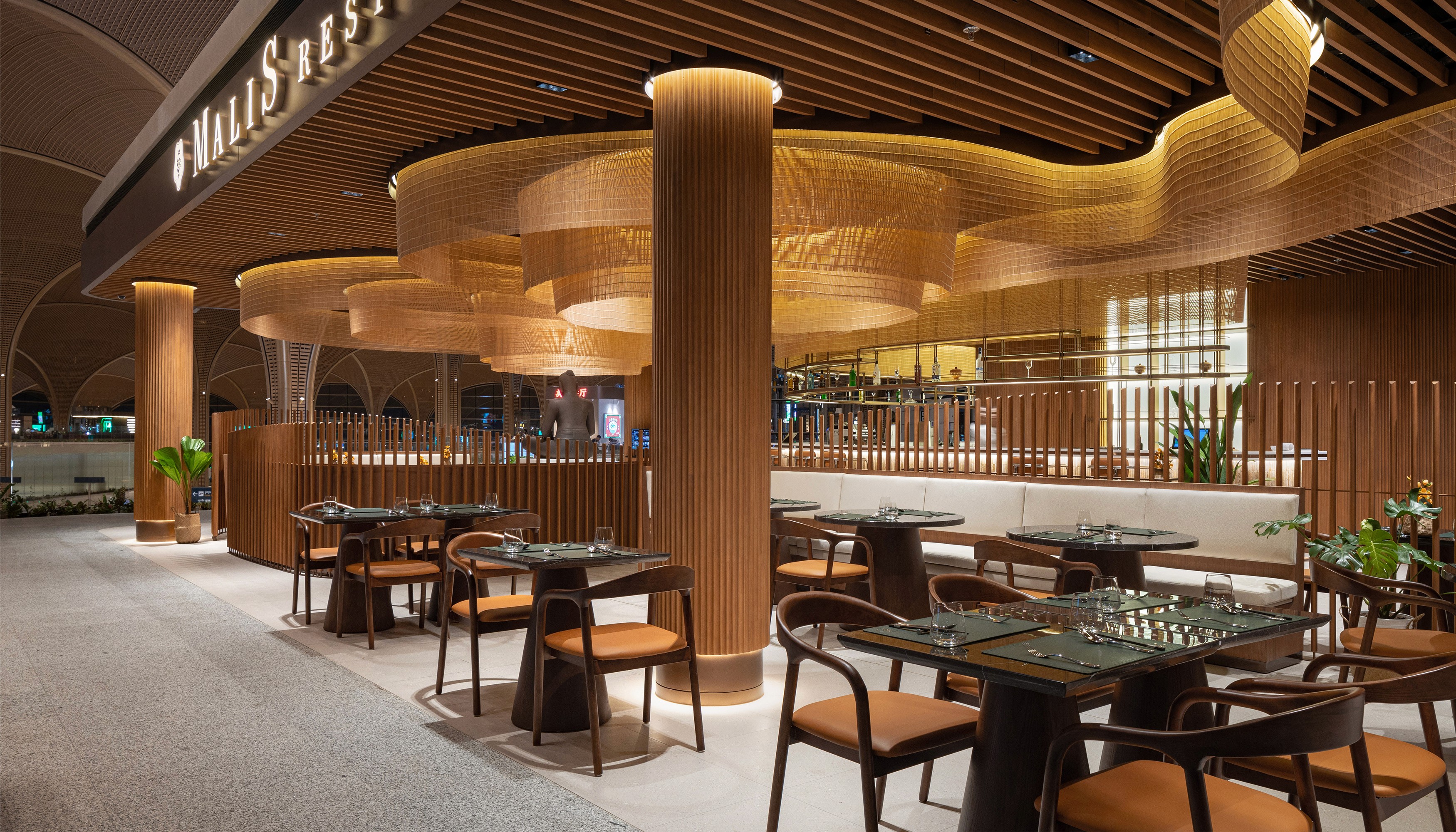
The material palette is restrained and deliberate. Terrazzo flooring, stained bamboo columns, woven brass screens, and marble surfaces establish durability and visual order. A woven golden mesh ceiling installation references Khmer silk weaving, giving the dining room a cultural anchor without turning the space into a themed interior. The effect is controlled and legible, which is important in a high-traffic setting where guests need clarity as much as atmosphere.
Furniture in timber and leather, muted upholstery, and geometric banquettes further support that sense of composure. Even the bar, often the most active point in a restaurant, is handled as a measured counterpoint, with ribbed timber cladding, bronze trims, and green patterned flooring.
Operational flow as a design driver
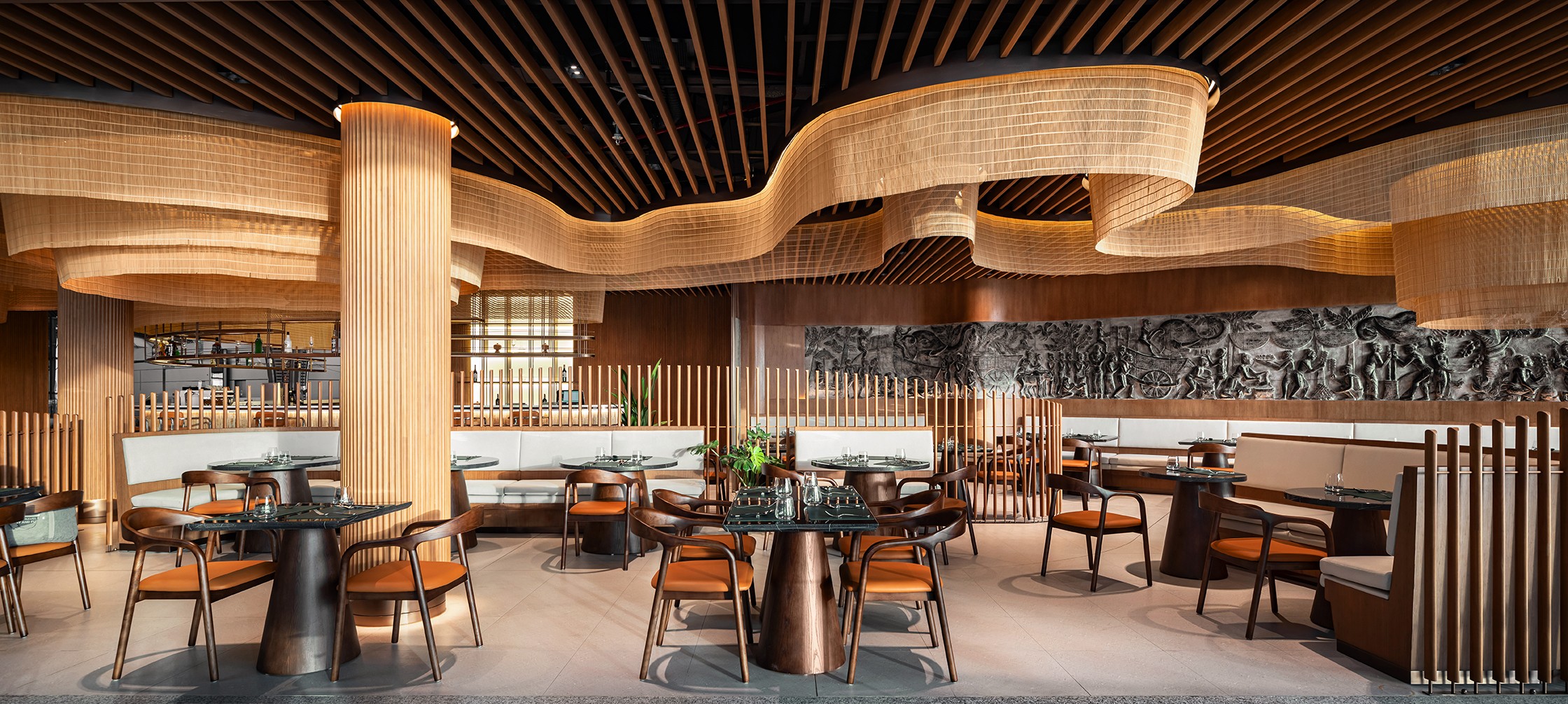
Open dining at Malis Restaurant combines banquette seating, curved ceiling forms, and cultural detailing within Techo International Airport.
Airport restaurants must perform under pressure. Passenger volumes change quickly, dwell time is limited, and service teams need circulation that avoids disruption. Malis addresses these conditions through spatial sequencing.
The restaurant presents a recognizable façade to the terminal concourse, helping the space read clearly from the public route. Staff access is separated from guest movement, and goods delivery is handled through discrete back-of-house circulation. These decisions reduce friction in daily operations and support reliable service.
Seating is also organized for different user types. Banquettes support privacy and efficient use of space. Bar seating suits passengers with limited time. Terrace tables create visibility and attract passing traffic. Together, these choices support both guest comfort and revenue performance.
Material continuity and cultural reference
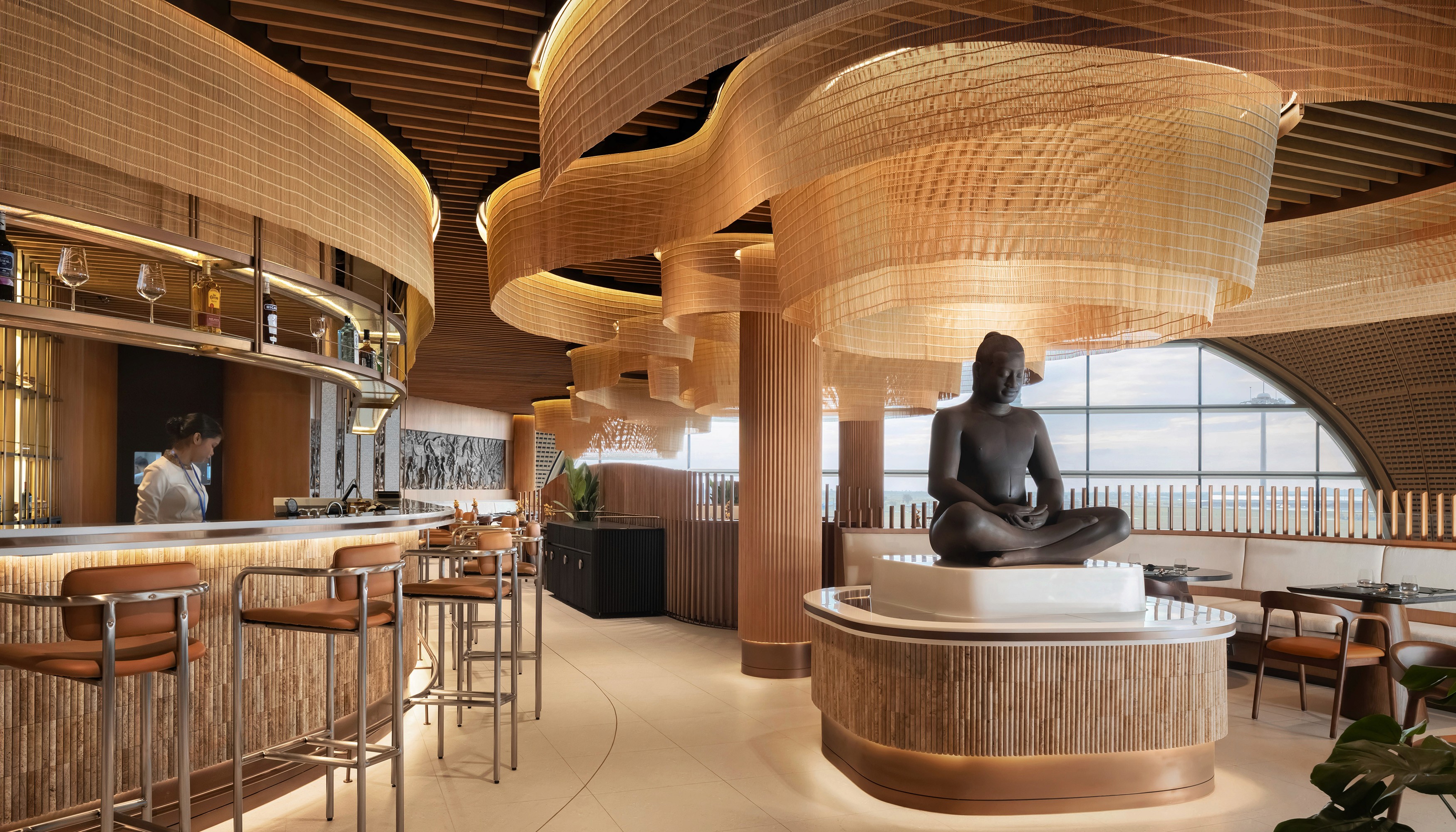
Sculptural lighting and a central Buddha figure shape the interior atmosphere of Malis Restaurant at Techo International Airport, Phnom Penh.
The project uses material and detail to connect contemporary hospitality with Cambodian craft. The ceiling installation recalls silk weaving, while stained bamboo columns introduce a vertical rhythm that is both structural and visual. Brass, stone, terrazzo, and marble provide the durability needed for constant use in a terminal setting.
Bas-relief wall panels and lotus-inspired motifs add cultural reference in a controlled way. These elements are not used as decoration alone. They support the spatial identity of the restaurant and reinforce the idea that cultural continuity can be expressed through material logic, not only through ornament.
Cambodia in the regional hospitality conversation
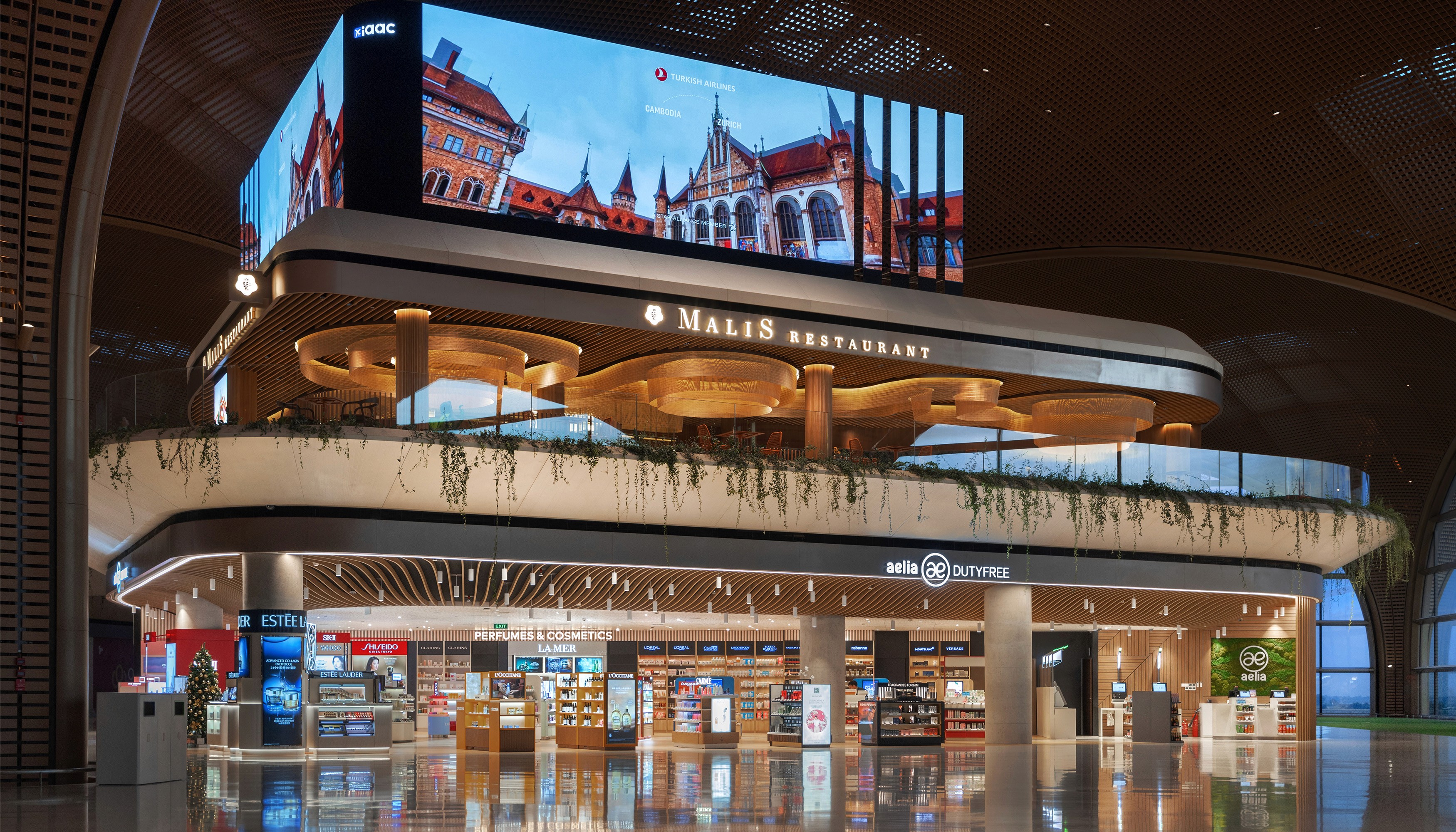
Malis Restaurant at Techo International Airport positions Cambodian hospitality design within a regional context, meeting international standards for transit infrastructure and high-volume passenger experience.
Across Southeast Asia, airports and transport hubs have become important sites for hospitality design. International terminals in Singapore, Doha, and Istanbul have demonstrated that dining spaces can contribute to a wider travel experience rather than simply servicing it.
Malis positions Phnom Penh within that discussion. The project does not imitate regional benchmarks. Instead, it establishes a Cambodian response that is grounded in local craft, operational clarity, and brand consistency. That balance matters in a market where hospitality is increasingly evaluated not only by visual identity, but by how effectively a space performs under real conditions.
What this project shows
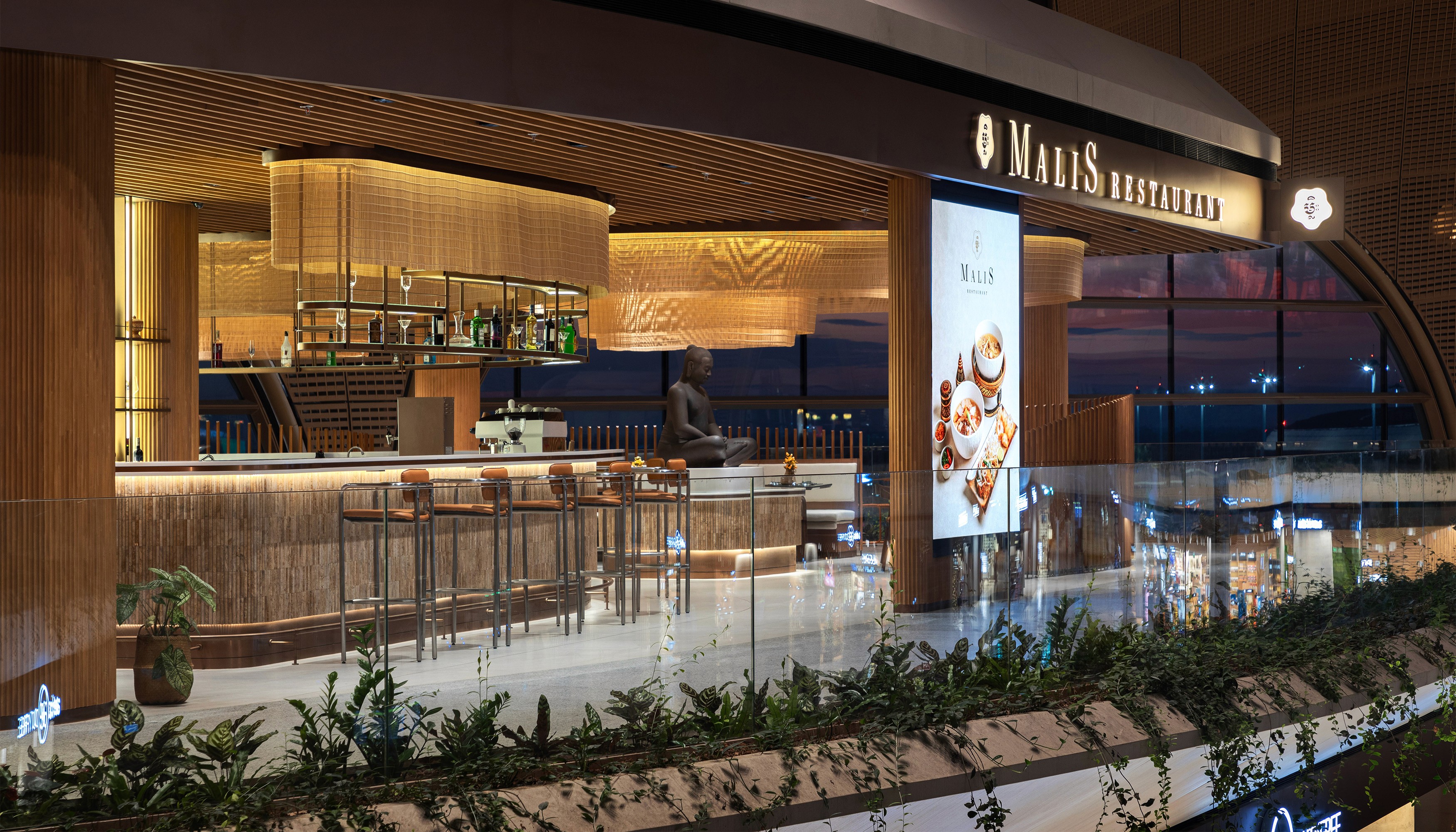
Malis Restaurant viewed from the apron at dusk, highlighting its presence within Techo International Airport and Phnom Penh’s evolving hospitality offer.
Malis at Techo International Airport offers several lessons for hospitality design in Cambodia.
First impressions matter, especially at points of arrival.
Operational planning is part of guest experience.
Cultural reference is stronger when it is built into the structure of the space.
Calm can be a design value, not just an atmosphere.
The project demonstrates that airport hospitality does not need to choose between efficiency and cultural expression. When both are handled with discipline, the result is a space that is commercially functional, visually clear, and recognizably Cambodian.
As Cambodia continues to invest in new gateways, hotels, resorts, and mixed-use destinations, projects like Malis suggest a clear direction for the sector. Hospitality spaces can be designed to perform operationally while still carrying cultural meaning. That combination is what gives them long-term relevance.
Airports shape first impressions. They are not only transit environments, they are also public-facing spaces where a country’s identity, service standards, and design priorities become visible at scale. Techo International Airport in Phnom Penh places this question in a Cambodian context, where hospitality must operate under the conditions of a fast-moving international terminal while still reflecting local culture.
Malis Restaurant responds to that brief through a design that balances cultural narrative with operational precision. It is not treated as a standalone dining room, but as part of the broader passenger experience at one of Cambodia’s most significant new gateways. The project shows how hospitality design can support function, brand clarity, and national identity at the same time.
Malis as a Cambodian hospitality brand in transit
The entrance to Malis Restaurant at Techo International Airport, where timber detailing and branded signage define the arrival sequence.
Malis carries a strong brand position as a Phnom Penh heritage restaurant operated by Thalias Hospitality Group, known for Living Cambodian Cuisine. At Techo International Airport, that identity needed to translate into a setting shaped by security, passenger flow, and short dwell times.
The 346.8 m² floorplate accommodates 92 guests across banquette seating, private tables, bar counters, and a terrace. The layout is divided with clear intent, separating front of house, bar, and kitchen functions so that staff movement, service delivery, and guest circulation can operate without conflict. In an airport environment, that level of planning is essential. It supports both service speed and consistency, while preserving a clear guest experience.
Calm as a design strategy
A circular backlit bar at Malis Restaurant, Techo International Airport, designed to support efficient airport hospitality in Phnom Penh.
One of the most relevant ideas in airport hospitality is calm. In terminals defined by noise, movement, and time pressure, spaces that reduce visual and sensory load become valuable. Malis uses this principle without resorting to theatrical gestures.
The material palette is restrained and deliberate. Terrazzo flooring, stained bamboo columns, woven brass screens, and marble surfaces establish durability and visual order. A woven golden mesh ceiling installation references Khmer silk weaving, giving the dining room a cultural anchor without turning the space into a themed interior. The effect is controlled and legible, which is important in a high-traffic setting where guests need clarity as much as atmosphere.
Furniture in timber and leather, muted upholstery, and geometric banquettes further support that sense of composure. Even the bar, often the most active point in a restaurant, is handled as a measured counterpoint, with ribbed timber cladding, bronze trims, and green patterned flooring.
Operational flow as a design driver
Open dining at Malis Restaurant combines banquette seating, curved ceiling forms, and cultural detailing within Techo International Airport.
Airport restaurants must perform under pressure. Passenger volumes change quickly, dwell time is limited, and service teams need circulation that avoids disruption. Malis addresses these conditions through spatial sequencing.
The restaurant presents a recognizable façade to the terminal concourse, helping the space read clearly from the public route. Staff access is separated from guest movement, and goods delivery is handled through discrete back-of-house circulation. These decisions reduce friction in daily operations and support reliable service.
Seating is also organized for different user types. Banquettes support privacy and efficient use of space. Bar seating suits passengers with limited time. Terrace tables create visibility and attract passing traffic. Together, these choices support both guest comfort and revenue performance.
Material continuity and cultural reference
Sculptural lighting and a central Buddha figure shape the interior atmosphere of Malis Restaurant at Techo International Airport, Phnom Penh.
The project uses material and detail to connect contemporary hospitality with Cambodian craft. The ceiling installation recalls silk weaving, while stained bamboo columns introduce a vertical rhythm that is both structural and visual. Brass, stone, terrazzo, and marble provide the durability needed for constant use in a terminal setting.
Bas-relief wall panels and lotus-inspired motifs add cultural reference in a controlled way. These elements are not used as decoration alone. They support the spatial identity of the restaurant and reinforce the idea that cultural continuity can be expressed through material logic, not only through ornament.
Cambodia in the regional hospitality conversation
Malis Restaurant at Techo International Airport positions Cambodian hospitality design within a regional context, meeting international standards for transit infrastructure and high-volume passenger experience.
Across Southeast Asia, airports and transport hubs have become important sites for hospitality design. International terminals in Singapore, Doha, and Istanbul have demonstrated that dining spaces can contribute to a wider travel experience rather than simply servicing it.
Malis positions Phnom Penh within that discussion. The project does not imitate regional benchmarks. Instead, it establishes a Cambodian response that is grounded in local craft, operational clarity, and brand consistency. That balance matters in a market where hospitality is increasingly evaluated not only by visual identity, but by how effectively a space performs under real conditions.
What this project shows
Malis Restaurant viewed from the apron at dusk, highlighting its presence within Techo International Airport and Phnom Penh’s evolving hospitality offer.
Malis at Techo International Airport offers several lessons for hospitality design in Cambodia.
First impressions matter, especially at points of arrival.
Operational planning is part of guest experience.
Cultural reference is stronger when it is built into the structure of the space.
Calm can be a design value, not just an atmosphere.
The project demonstrates that airport hospitality does not need to choose between efficiency and cultural expression. When both are handled with discipline, the result is a space that is commercially functional, visually clear, and recognizably Cambodian.
As Cambodia continues to invest in new gateways, hotels, resorts, and mixed-use destinations, projects like Malis suggest a clear direction for the sector. Hospitality spaces can be designed to perform operationally while still carrying cultural meaning. That combination is what gives them long-term relevance.
Airports shape first impressions. They are not only transit environments, they are also public-facing spaces where a country’s identity, service standards, and design priorities become visible at scale. Techo International Airport in Phnom Penh places this question in a Cambodian context, where hospitality must operate under the conditions of a fast-moving international terminal while still reflecting local culture.
Malis Restaurant responds to that brief through a design that balances cultural narrative with operational precision. It is not treated as a standalone dining room, but as part of the broader passenger experience at one of Cambodia’s most significant new gateways. The project shows how hospitality design can support function, brand clarity, and national identity at the same time.
Malis as a Cambodian hospitality brand in transit
The entrance to Malis Restaurant at Techo International Airport, where timber detailing and branded signage define the arrival sequence.
Malis carries a strong brand position as a Phnom Penh heritage restaurant operated by Thalias Hospitality Group, known for Living Cambodian Cuisine. At Techo International Airport, that identity needed to translate into a setting shaped by security, passenger flow, and short dwell times.
The 346.8 m² floorplate accommodates 92 guests across banquette seating, private tables, bar counters, and a terrace. The layout is divided with clear intent, separating front of house, bar, and kitchen functions so that staff movement, service delivery, and guest circulation can operate without conflict. In an airport environment, that level of planning is essential. It supports both service speed and consistency, while preserving a clear guest experience.
Calm as a design strategy
A circular backlit bar at Malis Restaurant, Techo International Airport, designed to support efficient airport hospitality in Phnom Penh.
One of the most relevant ideas in airport hospitality is calm. In terminals defined by noise, movement, and time pressure, spaces that reduce visual and sensory load become valuable. Malis uses this principle without resorting to theatrical gestures.
The material palette is restrained and deliberate. Terrazzo flooring, stained bamboo columns, woven brass screens, and marble surfaces establish durability and visual order. A woven golden mesh ceiling installation references Khmer silk weaving, giving the dining room a cultural anchor without turning the space into a themed interior. The effect is controlled and legible, which is important in a high-traffic setting where guests need clarity as much as atmosphere.
Furniture in timber and leather, muted upholstery, and geometric banquettes further support that sense of composure. Even the bar, often the most active point in a restaurant, is handled as a measured counterpoint, with ribbed timber cladding, bronze trims, and green patterned flooring.
Operational flow as a design driver
Open dining at Malis Restaurant combines banquette seating, curved ceiling forms, and cultural detailing within Techo International Airport.
Airport restaurants must perform under pressure. Passenger volumes change quickly, dwell time is limited, and service teams need circulation that avoids disruption. Malis addresses these conditions through spatial sequencing.
The restaurant presents a recognizable façade to the terminal concourse, helping the space read clearly from the public route. Staff access is separated from guest movement, and goods delivery is handled through discrete back-of-house circulation. These decisions reduce friction in daily operations and support reliable service.
Seating is also organized for different user types. Banquettes support privacy and efficient use of space. Bar seating suits passengers with limited time. Terrace tables create visibility and attract passing traffic. Together, these choices support both guest comfort and revenue performance.
Material continuity and cultural reference
Sculptural lighting and a central Buddha figure shape the interior atmosphere of Malis Restaurant at Techo International Airport, Phnom Penh.
The project uses material and detail to connect contemporary hospitality with Cambodian craft. The ceiling installation recalls silk weaving, while stained bamboo columns introduce a vertical rhythm that is both structural and visual. Brass, stone, terrazzo, and marble provide the durability needed for constant use in a terminal setting.
Bas-relief wall panels and lotus-inspired motifs add cultural reference in a controlled way. These elements are not used as decoration alone. They support the spatial identity of the restaurant and reinforce the idea that cultural continuity can be expressed through material logic, not only through ornament.
Cambodia in the regional hospitality conversation
Malis Restaurant at Techo International Airport positions Cambodian hospitality design within a regional context, meeting international standards for transit infrastructure and high-volume passenger experience.
Across Southeast Asia, airports and transport hubs have become important sites for hospitality design. International terminals in Singapore, Doha, and Istanbul have demonstrated that dining spaces can contribute to a wider travel experience rather than simply servicing it.
Malis positions Phnom Penh within that discussion. The project does not imitate regional benchmarks. Instead, it establishes a Cambodian response that is grounded in local craft, operational clarity, and brand consistency. That balance matters in a market where hospitality is increasingly evaluated not only by visual identity, but by how effectively a space performs under real conditions.
What this project shows
Malis Restaurant viewed from the apron at dusk, highlighting its presence within Techo International Airport and Phnom Penh’s evolving hospitality offer.
Malis at Techo International Airport offers several lessons for hospitality design in Cambodia.
First impressions matter, especially at points of arrival.
Operational planning is part of guest experience.
Cultural reference is stronger when it is built into the structure of the space.
Calm can be a design value, not just an atmosphere.
The project demonstrates that airport hospitality does not need to choose between efficiency and cultural expression. When both are handled with discipline, the result is a space that is commercially functional, visually clear, and recognizably Cambodian.
As Cambodia continues to invest in new gateways, hotels, resorts, and mixed-use destinations, projects like Malis suggest a clear direction for the sector. Hospitality spaces can be designed to perform operationally while still carrying cultural meaning. That combination is what gives them long-term relevance.