Workplace Design for Cambodia’s Business Leaders and HR Teams
Workplace Design for Cambodia’s Business Leaders and HR Teams

Intentional zoning and high-quality materiality support both focused work and informal exchange. Multilateral Bank Office, the first LEED Gold certified workplace in Cambodia.
In Cambodia’s rapidly evolving corporate landscape, the office is no longer just a backdrop for business. The physical environment has become a primary lever for talent retention and operational output. International studies show that employees who are satisfied with their physical workspace are roughly a third more likely to be satisfied in their job overall. For business owners, that satisfaction links directly to stronger engagement and lower staff turnover.
Poorly considered layouts can work against that outcome. Surveys of open-plan workplaces have found that more than a third of employees feel their current office design reduces productivity. This is a real risk for firms in Phnom Penh scaling quickly within spaces that were never planned for modern workflows.
Research into workplace performance also shows that design choices can deliver measurable gains. Optimizing access to natural light and views can lift productivity by nearly 20 percent. Organizations that align their offices with health and wellness principles have reported cutting absenteeism in half and significantly lowering turnover rates.
For business leaders and HR teams, the question is not whether office design matters. The real question is which specific levers will support performance, culture, and long-term value.
Key takeaways: how workplace design improves ROI
Operational efficiency: Transitioning to Activity-Based Working and intentional zoning can reduce wasted square footage by up to 70 percent in underutilized areas like traditional boardrooms.
Productivity gains: Natural light and advanced acoustic control can lift team productivity by nearly 20 percent and eliminate the "noise tax" that drains billable hours.
Talent retention: Health-aligned workspaces that prioritize air quality and biophilic elements have been shown to reduce staff turnover and cut absenteeism by 50 percent.
Brand equity: A deliberate spatial hierarchy and high-quality materiality serve as a physical manifestation of your brand, building immediate trust with global partners and local talent.
Asset longevity: Future-proofing through modular infrastructure and smart building technology protects your initial capital investment, allowing the office to scale alongside growth targets.
Office zoning and productivity
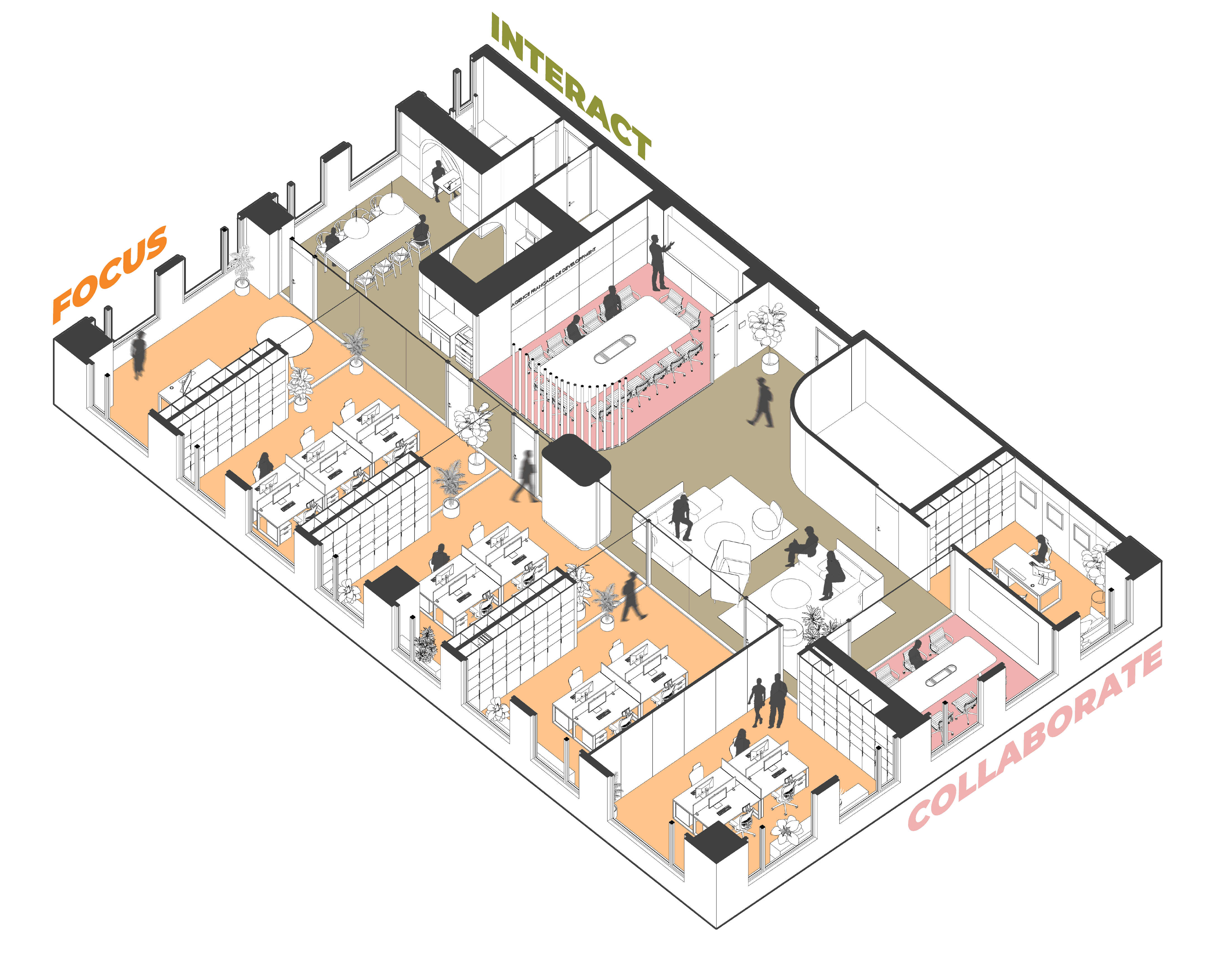
Workplace zoning replaces the generic open-plan with a high-performance map of daily operations, balancing deep focus with collaborative zones.
Every square meter must justify its cost. Many business owners initially view open plan as the most economical option, yet without a clear spatial logic, these spaces often become productivity sinks due to acoustic distractions and a lack of privacy. A high-performance workplace requires a precise map of how the company actually works throughout the day.
Activity-based working and office layout design

Social anchors serve as the heart of the office, encouraging spontaneous cross-departmental interaction while maintaining a clear spatial hierarchy. Unilever Cambodia HQ.
The most successful firms are moving away from fixed-desk ratios toward Activity-Based Working. This architectural approach involves designing specific neighborhoods tailored to the diverse tasks your team performs throughout the day. By analyzing departmental flow, we can implement:
High-focus zones: Acoustically shielded areas positioned away from high-traffic corridors, specifically for analysts, legal teams, or project managers who require uninterrupted concentration.
Agile collaboration hubs: Semi-private huddle spaces equipped for rapid stand-up meetings, placed to prevent noise bleed into quiet zones.
Social anchors: Centralized breakout areas that serve as the heart of the office, encouraging spontaneous cross-departmental interactions that drive innovation.
Maximizing square footage and cost efficiency
Intentional zoning is a direct lever for the bottom line. By auditing how a team actually uses space, many projects reveal that traditional oversized boardrooms sit empty 70 percent of the day. Replacing these with a versatile mix of smaller zoom rooms and flexible, modular social spaces can increase formal capacity while reducing the total real estate footprint.
A well-planned floor plan supports both business objectives and the needs of clients. It does not just improve the workplace atmosphere; it creates a scalable environment that functions as a high-yield asset.
Acoustic design for open-plan offices
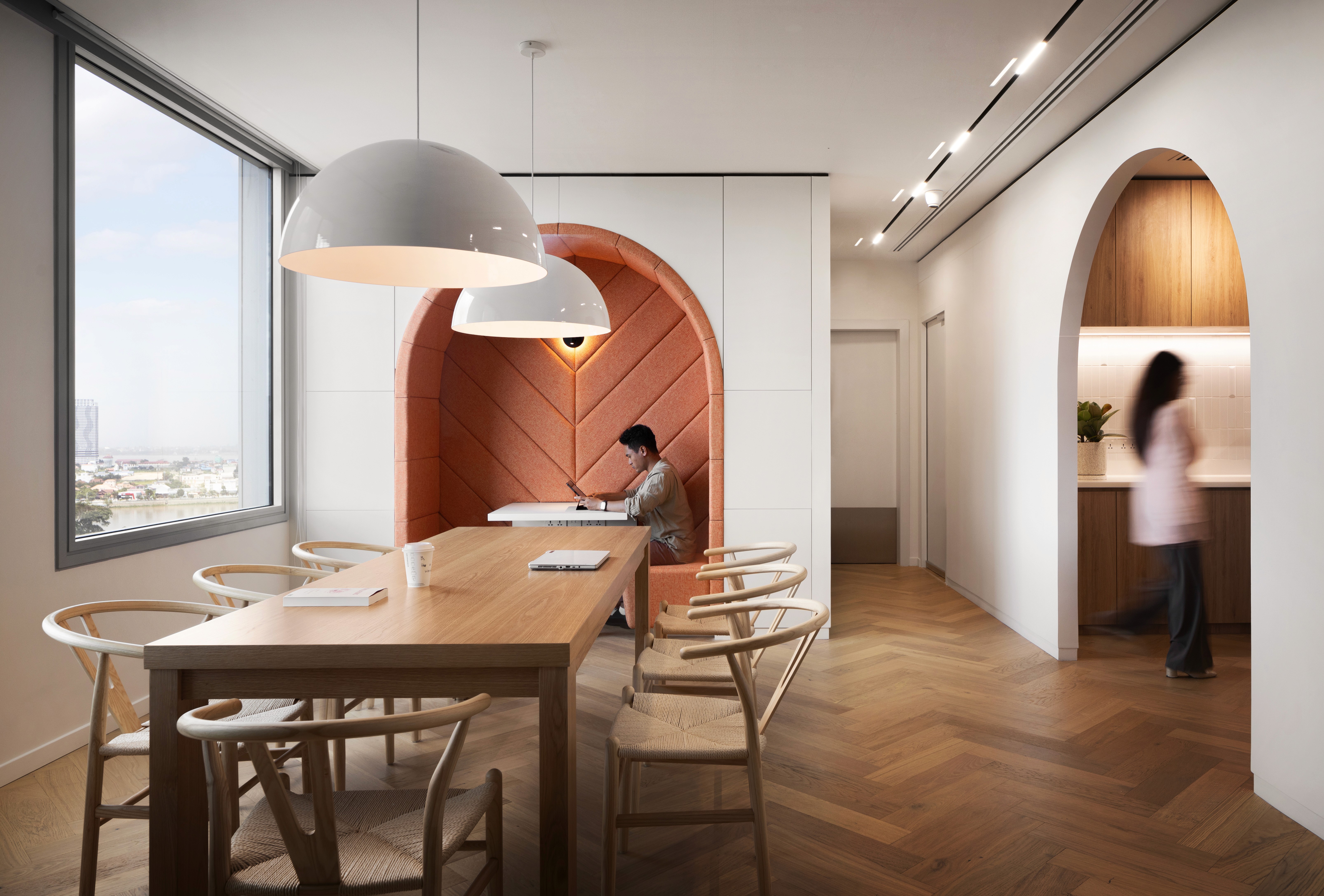
Integrated acoustic booths and purposeful spatial buffers eliminate the "noise tax" by protecting deep focus within high-density environments. AFD Office, Phnom Penh.
Zoning provides the structural framework of a high-performance office, while acoustic control manages its operational layer. For many corporate leaders, the shift to open-plan layouts has created a noise tax on productivity. Research indicates that it can take an employee up to 23 minutes to regain deep focus after a single auditory distraction. These interruptions represent a significant, yet hidden, drain on billable hours and operational output.
Engineering acoustic privacy
Acoustic performance focuses on speech privacy and the management of sound decay. By integrating high-performance materials and spatial buffers, we ensure that a lively brainstorming session in a collaboration hub does not compromise the concentrated analysis required in a nearby focus zone. This involves a multi-layered approach:
Absorptive surfaces: Acoustic ceiling baffles, wall panels, and specialized flooring intercept ambient noise before it travels across the floor plate.
Sound masking systems: Subtle, low-level background sound, often called pink noise, raises the ambient floor of the office, making distant conversations unintelligible and less distracting.
Acoustic buffers: Functional partitions like library shelving, felt-lined booths, or greenery create physical and auditory barriers between departments.
The ROI of quiet zones
Dedicated quiet zones are a major differentiator in the competition for talent. Top-tier professionals, particularly in legal, finance, and creative sectors, prioritize offices that respect their requirement for deep work. By designing enclosed phone booths for private calls and designated quiet areas where conversation is restricted, you provide the team with tools to manage cognitive load.
An office that masters acoustics holds a competitive advantage. It signals to both the team and clients that the organization values precision, confidentiality, and the well-being of its people. Design directly supports business objectives when it creates an environment where high-value work can occur.
Natural light and air quality in office design
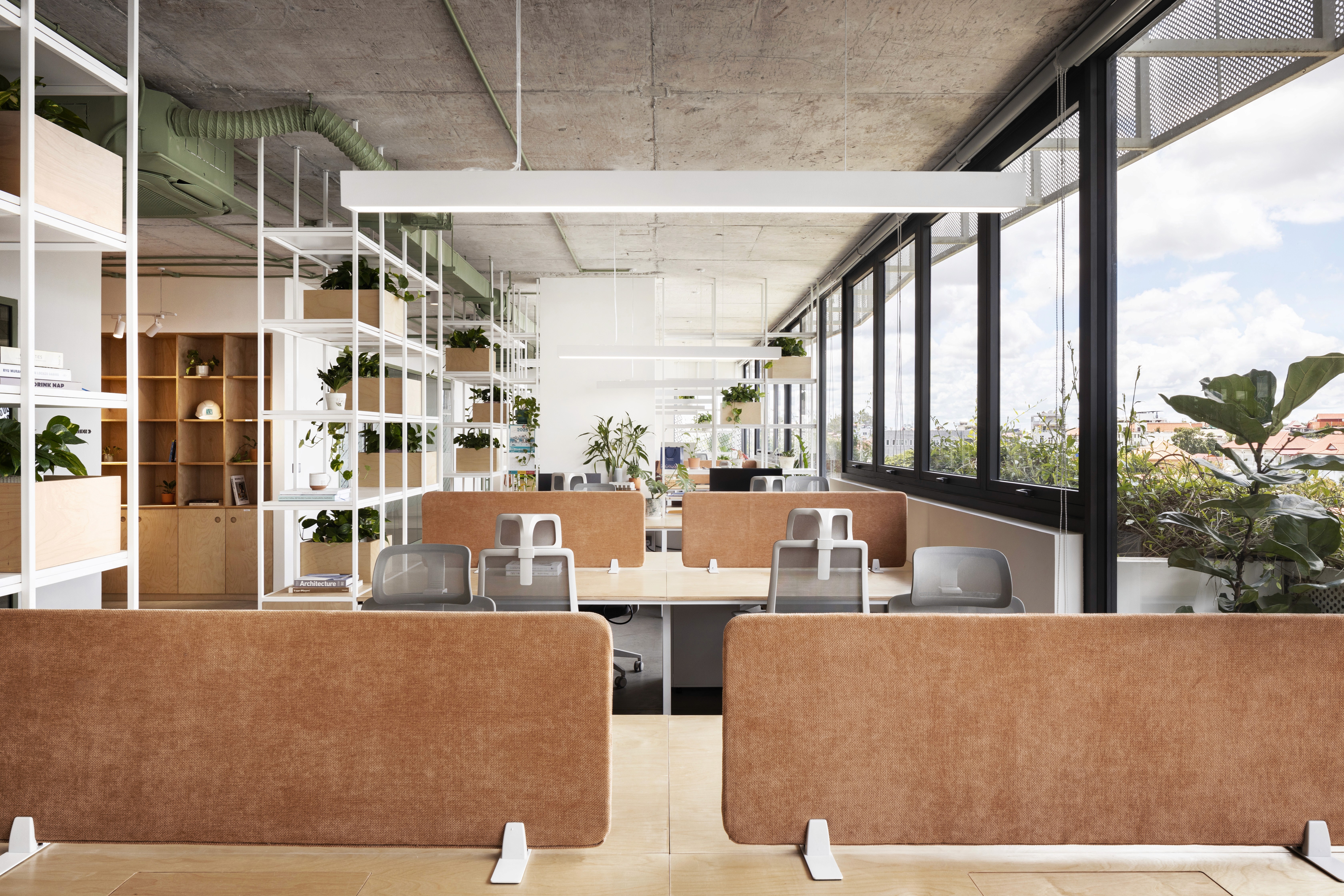
Focused space planning prioritizes daylight harvesting and biophilic elements to regulate circadian rhythms and reduce employee burnout. ULS HQ, Siem Reap.
Optimizing a workspace for natural light and air quality provides a direct lever for increasing operational output. Data indicates that these environmental factors can lift productivity by nearly 20 percent. That margin can separate a team that is merely functioning from one that is performing at its peak.
Maximizing natural light and views
Effective space planning prioritizes daylight harvesting by placing high-density work zones near the building’s perimeter. Glazed partitions and low-profile furniture allow light to penetrate deeper into the floor plate, reducing reliance on harsh artificial lighting. This approach regulates circadian rhythms, supporting better focus during the day and improved recovery at night.
The impact of indoor air quality
Air quality is a critical, yet invisible, factor in staff performance. Poorly ventilated offices lead to a buildup of CO2, which degrades cognitive function and decision-making. Integrating advanced filtration and monitoring systems ensures that the office remains a high-oxygen environment. When combined with biophilic elements like internal greenery or living walls, these systems also help manage humidity and reduce the presence of volatile organic compounds (VOCs) often found in office carpets and paints.
Biophilia as a high-value asset
Biophilic design creates a sensory connection to the natural world through organic textures, natural materials like timber, and varied light patterns. This is a powerful tool for stress reduction. Organizations that embrace these principles report significantly lower levels of employee burnout and a 50 percent reduction in absenteeism. Providing a calm, contemporary environment away from the bustle of the city is a major draw for top-tier talent.
How office design communicates brand identity
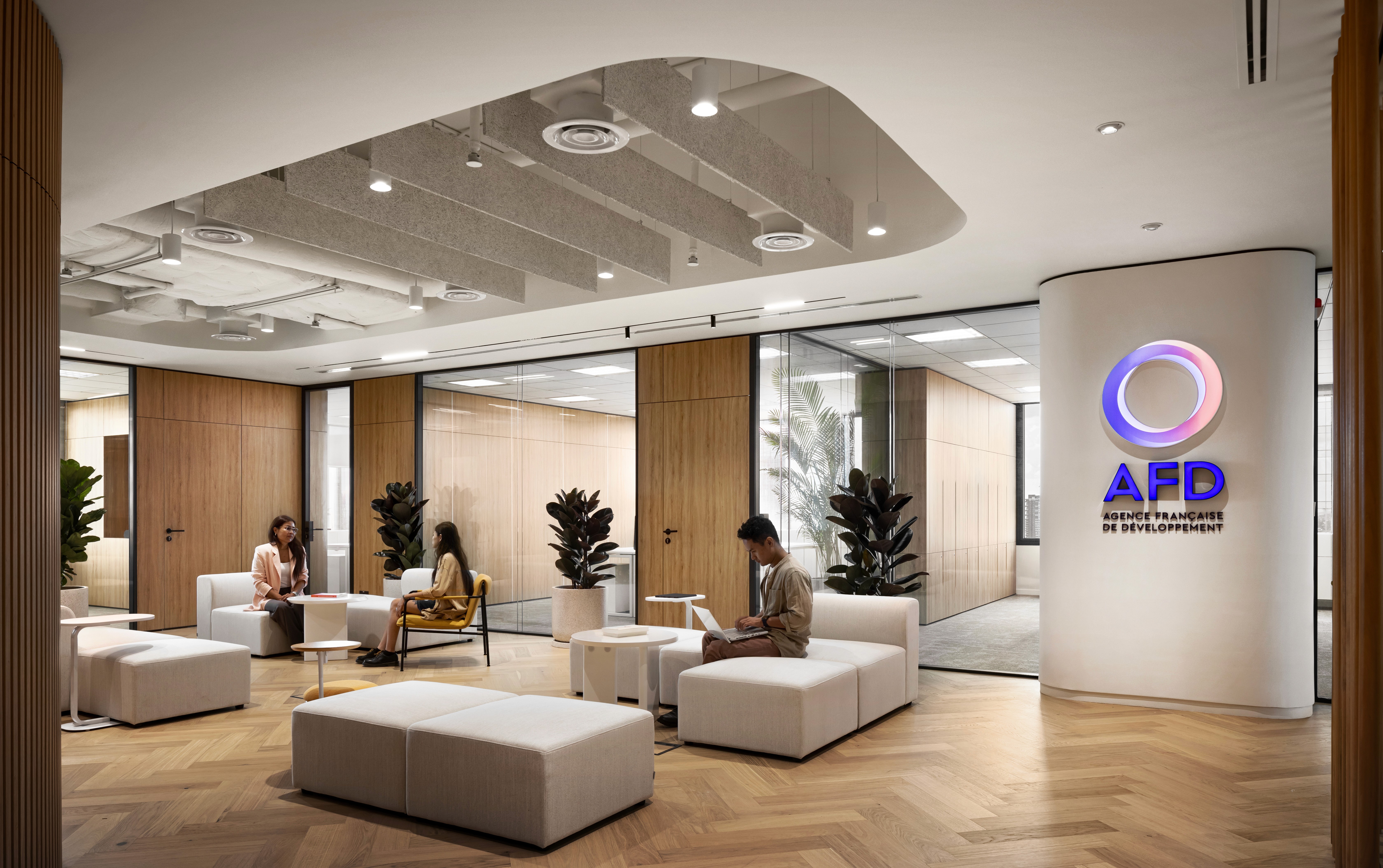
A deliberate spatial hierarchy and high-quality materiality communicate institutional stability and international standards to global partners. AFD Office, Phnom Penh.
The office environment is a primary tool for communicating stability, innovation, and international standards to both global partners and local talent. When design is aligned with a specific brand narrative, it moves beyond aesthetics to become a functional extension of business development.
Spatial hierarchy and the client journey
The front-of-house experience is a critical touchpoint for client trust. For a financial or legal firm, the transition from a high-traffic corridor into a calm, contemporary reception area signals a shift toward precision and confidentiality. That experience is shaped through deliberate layout logic:
Materiality as a brand signal: A palette of engineered timber, stone, and high-grade glass partitions communicates a commitment to quality and longevity. These materials are selected for their acoustic properties and their ability to maintain a day-one appearance under high-use conditions.
The threshold experience: An intuitive flow from the entrance to client-facing meeting rooms ensures that visitors feel prioritized. Integrated technology and concealed storage within these rooms maintain a clutter-free environment that reflects organizational discipline.
Internal culture and the back-of-house experience
The back-of-house areas reinforce the brand narrative for the team. If a company claims to value innovation and flat hierarchies, the architecture must support that through its layout. Placing open-plan workstations in the primary daylight zones near windows, while moving private offices or utility rooms to the core of the building, signals that the well-being of the entire team is a corporate priority.
Social spaces also matter. A communal lounge creates a dedicated setting for informal knowledge sharing that drives cross-departmental innovation.
Aligning design with business objectives
Every architectural choice should support a specific business goal. If the objective is to attract top-tier Gen Z talent, the design may prioritize high-tech agile zones and wellness-focused biophilic elements. If the goal is to project institutional authority, the focus shifts to a more structured, timeless aesthetic with superior acoustic privacy. Treating the office as a commercial asset rather than an overhead cost ensures that the physical environment works as hard as the team to win the market.
How to future-proof an office
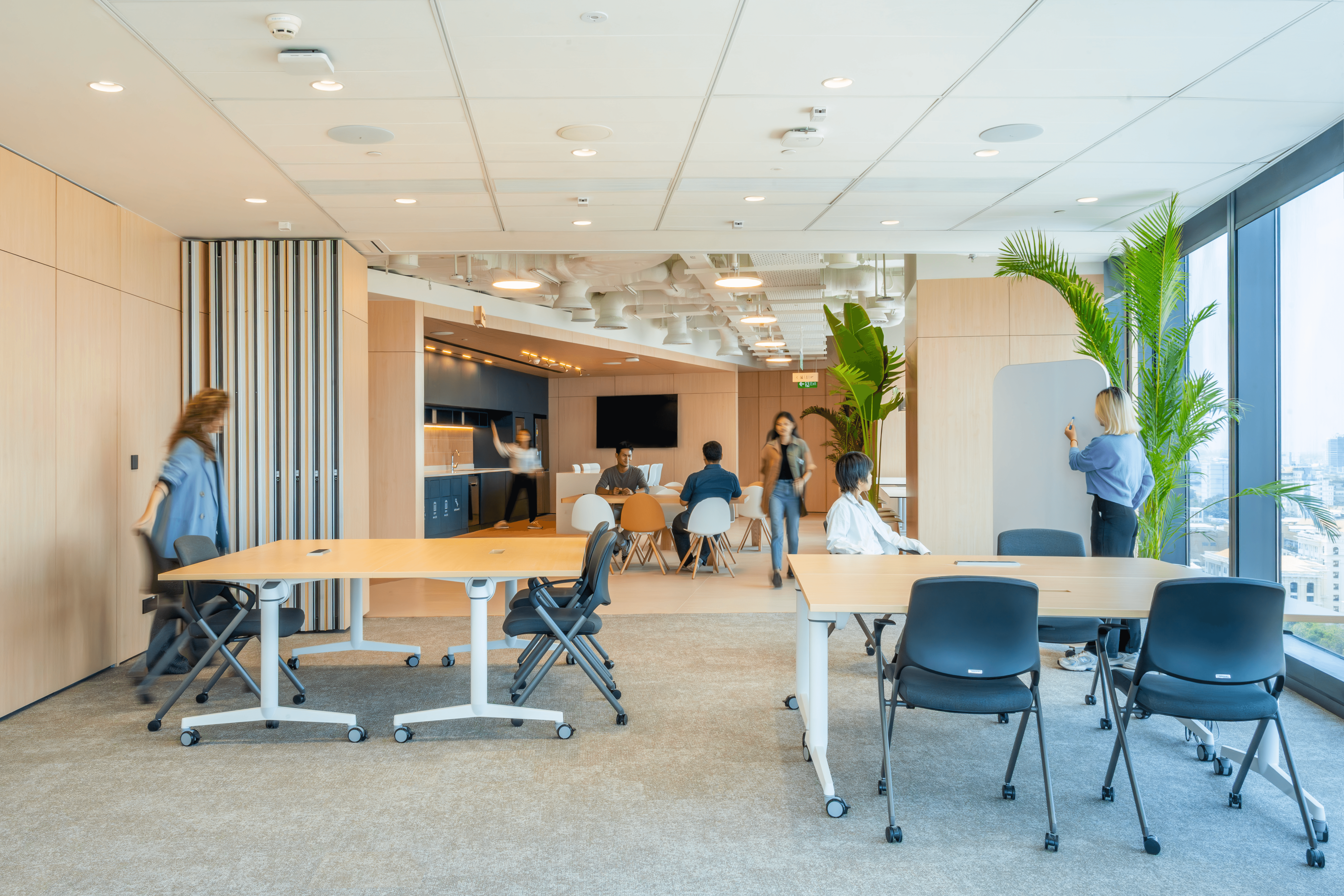
Spatial agility and movable furniture systems allow the floor plate to be reconfigured for diverse functions. Multilateral Bank Office, Phnom Penh.
A rigid office layout is a liability. The workplace must be a living system capable of adapting to shifting headcount, new technologies, and evolving departmental structures. Future-proofing is the design strategy of building flexibility into the bones of the office to protect the initial capital investment and ensure long-term operational continuity.
Modular infrastructure and spatial agility
True adaptability begins with base build integration. Modular partitions and raised flooring systems allow for rapid reconfiguration of the floor plate with minimal disruption to daily operations. This spatial agility is essential for firms that anticipate scaling teams or restructuring workflows:
Plug-and-play connectivity: Centralizing power and data distribution through accessible floor tracks or ceiling service systems allows desks and collaborative hubs to be relocated without expensive electrical rewiring.
Demountable partitioning: Replacing fixed drywall with high-performance glass or acoustic fabric systems enables a private office to be converted into a four-person huddle room in a single weekend. This allows formal capacity to expand or contract based on real-time business needs.
Technology integration and internal connectivity
The modern Cambodian office must effectively bridge the gap between physical and digital environments. Future-proofed design anticipates the ongoing necessity for remote collaboration and high-equity meeting experiences:
Acoustic zoom rooms: Designing small, high-spec video conferencing pods that are acoustically isolated ensures that remote communication does not disrupt the focus of the open-plan team.
Smart building readiness: Integrating sensors for occupancy, air quality, and lighting allows business owners to collect data on how the office is actually used. This data-driven approach informs future expansion or consolidation strategies, ensuring that you are never paying for underutilized square footage.
Protecting your real estate investment
For a CEO or HR Director, a future-proofed office is a hedge against market volatility. By selecting durable, timeless materials and a flexible spatial framework, you extend the lifecycle of the fit-out and maintain a high-yield asset. This foresight signals to investors and partners that the organization is built for longevity and capable of navigating the complexities of Cambodia’s evolving commercial landscape.
How workplace design supports business performance
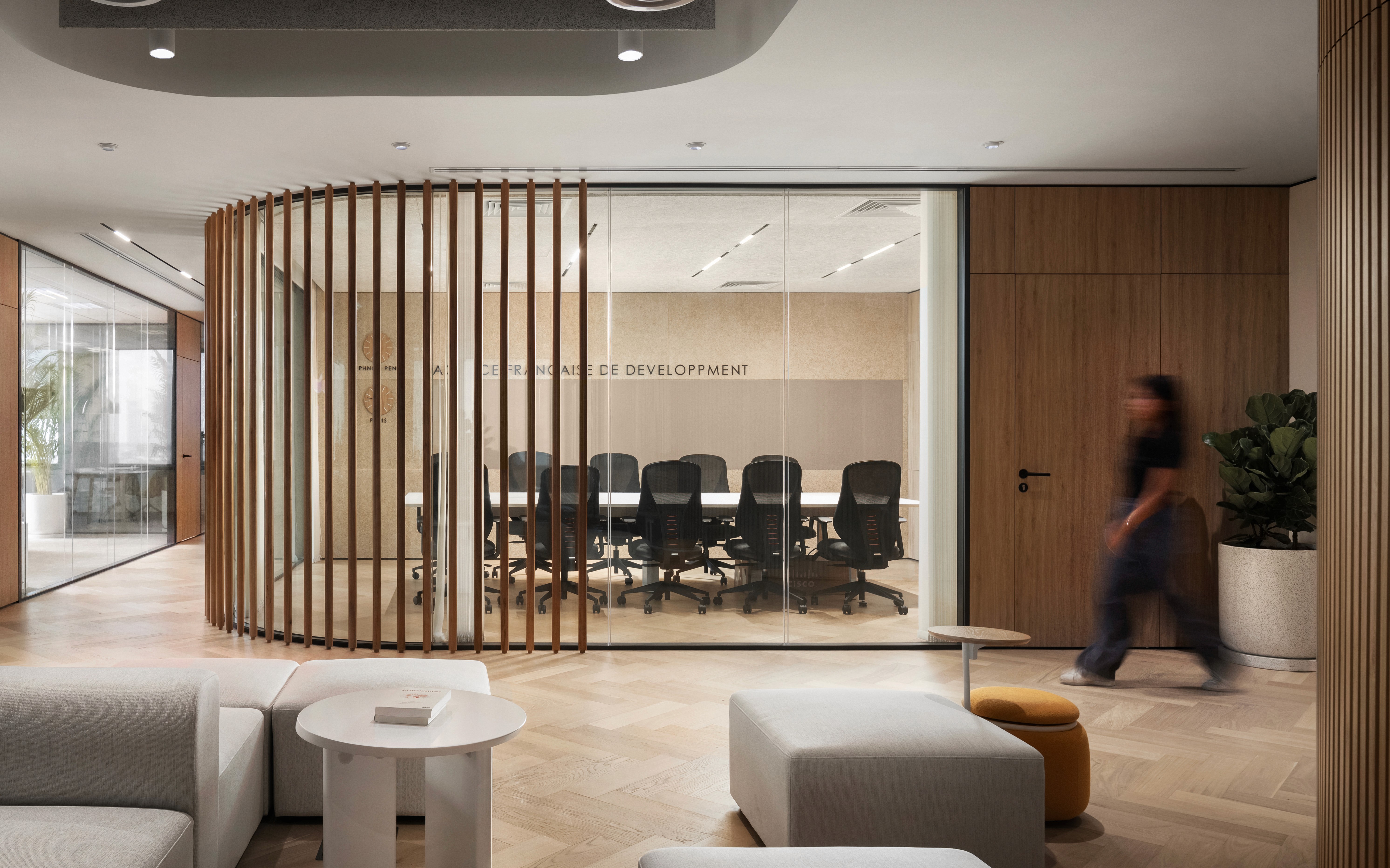
Aligning spatial zoning with brand narrative creates a high-performance environment that supports long-term commercial objectives. AFD Office, Phnom Penh.
In Cambodia’s commercial sector, the office is a high-performance tool that drives operational efficiency, talent retention, and brand equity. Focusing on spatial zoning, acoustic privacy, and environmental health allows business owners to create an environment that actively supports long-term commercial objectives.
The most successful workplaces treat design as a living system. Whether the goal is optimizing a current floor plate to reduce wasted square footage or planning a relocation, the objective remains the same: create a space that is resilient, functional, and aligned with the team inside it. Translating complex business needs into high-yield architectural solutions ensures that the physical environment is an investment in both human potential and asset longevity.
Aligning your physical environment with 2026 growth targets
A workplace audit can identify whether a current environment is supporting growth or acting as a hidden drain on productivity. For leadership teams and HR directors, evaluating the workspace is a critical step in preparing for the next phase of market expansion.
Evaluate space utilization: Analyze how current zones are used to identify immediate opportunities for operational and cost efficiency.
Strategic relocation planning: Ensure a new office is future-proofed from day one with a fit-out that aligns with technical requirements and brand narrative.
Workplace performance checklist: Review the essential architectural benchmarks for a high-performance office refurbishment in Cambodia.
Contact our team to discuss how design can support your business vision and operational goals.
In Cambodia’s rapidly evolving corporate landscape, the office is no longer just a backdrop for business. The physical environment has become a primary lever for talent retention and operational output. International studies show that employees who are satisfied with their physical workspace are roughly a third more likely to be satisfied in their job overall. For business owners, that satisfaction links directly to stronger engagement and lower staff turnover.
Poorly considered layouts can work against that outcome. Surveys of open-plan workplaces have found that more than a third of employees feel their current office design reduces productivity. This is a real risk for firms in Phnom Penh scaling quickly within spaces that were never planned for modern workflows.
Research into workplace performance also shows that design choices can deliver measurable gains. Optimizing access to natural light and views can lift productivity by nearly 20 percent. Organizations that align their offices with health and wellness principles have reported cutting absenteeism in half and significantly lowering turnover rates.
For business leaders and HR teams, the question is not whether office design matters. The real question is which specific levers will support performance, culture, and long-term value.
Key takeaways: how workplace design improves ROI
Operational efficiency: Transitioning to Activity-Based Working and intentional zoning can reduce wasted square footage by up to 70 percent in underutilized areas like traditional boardrooms.
Productivity gains: Natural light and advanced acoustic control can lift team productivity by nearly 20 percent and eliminate the "noise tax" that drains billable hours.
Talent retention: Health-aligned workspaces that prioritize air quality and biophilic elements have been shown to reduce staff turnover and cut absenteeism by 50 percent.
Brand equity: A deliberate spatial hierarchy and high-quality materiality serve as a physical manifestation of your brand, building immediate trust with global partners and local talent.
Asset longevity: Future-proofing through modular infrastructure and smart building technology protects your initial capital investment, allowing the office to scale alongside growth targets.
Office zoning and productivity
Workplace zoning replaces the generic open-plan with a high-performance map of daily operations, balancing deep focus with collaborative zones.
Every square meter must justify its cost. Many business owners initially view open plan as the most economical option, yet without a clear spatial logic, these spaces often become productivity sinks due to acoustic distractions and a lack of privacy. A high-performance workplace requires a precise map of how the company actually works throughout the day.
Activity-based working and office layout design
Social anchors serve as the heart of the office, encouraging spontaneous cross-departmental interaction while maintaining a clear spatial hierarchy. Unilever Cambodia HQ.
The most successful firms are moving away from fixed-desk ratios toward Activity-Based Working. This architectural approach involves designing specific neighborhoods tailored to the diverse tasks your team performs throughout the day. By analyzing departmental flow, we can implement:
High-focus zones: Acoustically shielded areas positioned away from high-traffic corridors, specifically for analysts, legal teams, or project managers who require uninterrupted concentration.
Agile collaboration hubs: Semi-private huddle spaces equipped for rapid stand-up meetings, placed to prevent noise bleed into quiet zones.
Social anchors: Centralized breakout areas that serve as the heart of the office, encouraging spontaneous cross-departmental interactions that drive innovation.
Maximizing square footage and cost efficiency
Intentional zoning is a direct lever for the bottom line. By auditing how a team actually uses space, many projects reveal that traditional oversized boardrooms sit empty 70 percent of the day. Replacing these with a versatile mix of smaller zoom rooms and flexible, modular social spaces can increase formal capacity while reducing the total real estate footprint.
A well-planned floor plan supports both business objectives and the needs of clients. It does not just improve the workplace atmosphere; it creates a scalable environment that functions as a high-yield asset.
Acoustic design for open-plan offices
Integrated acoustic booths and purposeful spatial buffers eliminate the "noise tax" by protecting deep focus within high-density environments. AFD Office, Phnom Penh.
Zoning provides the structural framework of a high-performance office, while acoustic control manages its operational layer. For many corporate leaders, the shift to open-plan layouts has created a noise tax on productivity. Research indicates that it can take an employee up to 23 minutes to regain deep focus after a single auditory distraction. These interruptions represent a significant, yet hidden, drain on billable hours and operational output.
Engineering acoustic privacy
Acoustic performance focuses on speech privacy and the management of sound decay. By integrating high-performance materials and spatial buffers, we ensure that a lively brainstorming session in a collaboration hub does not compromise the concentrated analysis required in a nearby focus zone. This involves a multi-layered approach:
Absorptive surfaces: Acoustic ceiling baffles, wall panels, and specialized flooring intercept ambient noise before it travels across the floor plate.
Sound masking systems: Subtle, low-level background sound, often called pink noise, raises the ambient floor of the office, making distant conversations unintelligible and less distracting.
Acoustic buffers: Functional partitions like library shelving, felt-lined booths, or greenery create physical and auditory barriers between departments.
The ROI of quiet zones
Dedicated quiet zones are a major differentiator in the competition for talent. Top-tier professionals, particularly in legal, finance, and creative sectors, prioritize offices that respect their requirement for deep work. By designing enclosed phone booths for private calls and designated quiet areas where conversation is restricted, you provide the team with tools to manage cognitive load.
An office that masters acoustics holds a competitive advantage. It signals to both the team and clients that the organization values precision, confidentiality, and the well-being of its people. Design directly supports business objectives when it creates an environment where high-value work can occur.
Natural light and air quality in office design
Focused space planning prioritizes daylight harvesting and biophilic elements to regulate circadian rhythms and reduce employee burnout. ULS HQ, Siem Reap.
Optimizing a workspace for natural light and air quality provides a direct lever for increasing operational output. Data indicates that these environmental factors can lift productivity by nearly 20 percent. That margin can separate a team that is merely functioning from one that is performing at its peak.
Maximizing natural light and views
Effective space planning prioritizes daylight harvesting by placing high-density work zones near the building’s perimeter. Glazed partitions and low-profile furniture allow light to penetrate deeper into the floor plate, reducing reliance on harsh artificial lighting. This approach regulates circadian rhythms, supporting better focus during the day and improved recovery at night.
The impact of indoor air quality
Air quality is a critical, yet invisible, factor in staff performance. Poorly ventilated offices lead to a buildup of CO2, which degrades cognitive function and decision-making. Integrating advanced filtration and monitoring systems ensures that the office remains a high-oxygen environment. When combined with biophilic elements like internal greenery or living walls, these systems also help manage humidity and reduce the presence of volatile organic compounds (VOCs) often found in office carpets and paints.
Biophilia as a high-value asset
Biophilic design creates a sensory connection to the natural world through organic textures, natural materials like timber, and varied light patterns. This is a powerful tool for stress reduction. Organizations that embrace these principles report significantly lower levels of employee burnout and a 50 percent reduction in absenteeism. Providing a calm, contemporary environment away from the bustle of the city is a major draw for top-tier talent.
How office design communicates brand identity
A deliberate spatial hierarchy and high-quality materiality communicate institutional stability and international standards to global partners. AFD Office, Phnom Penh.
The office environment is a primary tool for communicating stability, innovation, and international standards to both global partners and local talent. When design is aligned with a specific brand narrative, it moves beyond aesthetics to become a functional extension of business development.
Spatial hierarchy and the client journey
The front-of-house experience is a critical touchpoint for client trust. For a financial or legal firm, the transition from a high-traffic corridor into a calm, contemporary reception area signals a shift toward precision and confidentiality. That experience is shaped through deliberate layout logic:
Materiality as a brand signal: A palette of engineered timber, stone, and high-grade glass partitions communicates a commitment to quality and longevity. These materials are selected for their acoustic properties and their ability to maintain a day-one appearance under high-use conditions.
The threshold experience: An intuitive flow from the entrance to client-facing meeting rooms ensures that visitors feel prioritized. Integrated technology and concealed storage within these rooms maintain a clutter-free environment that reflects organizational discipline.
Internal culture and the back-of-house experience
The back-of-house areas reinforce the brand narrative for the team. If a company claims to value innovation and flat hierarchies, the architecture must support that through its layout. Placing open-plan workstations in the primary daylight zones near windows, while moving private offices or utility rooms to the core of the building, signals that the well-being of the entire team is a corporate priority.
Social spaces also matter. A communal lounge creates a dedicated setting for informal knowledge sharing that drives cross-departmental innovation.
Aligning design with business objectives
Every architectural choice should support a specific business goal. If the objective is to attract top-tier Gen Z talent, the design may prioritize high-tech agile zones and wellness-focused biophilic elements. If the goal is to project institutional authority, the focus shifts to a more structured, timeless aesthetic with superior acoustic privacy. Treating the office as a commercial asset rather than an overhead cost ensures that the physical environment works as hard as the team to win the market.
How to future-proof an office
Spatial agility and movable furniture systems allow the floor plate to be reconfigured for diverse functions. Multilateral Bank Office, Phnom Penh.
A rigid office layout is a liability. The workplace must be a living system capable of adapting to shifting headcount, new technologies, and evolving departmental structures. Future-proofing is the design strategy of building flexibility into the bones of the office to protect the initial capital investment and ensure long-term operational continuity.
Modular infrastructure and spatial agility
True adaptability begins with base build integration. Modular partitions and raised flooring systems allow for rapid reconfiguration of the floor plate with minimal disruption to daily operations. This spatial agility is essential for firms that anticipate scaling teams or restructuring workflows:
Plug-and-play connectivity: Centralizing power and data distribution through accessible floor tracks or ceiling service systems allows desks and collaborative hubs to be relocated without expensive electrical rewiring.
Demountable partitioning: Replacing fixed drywall with high-performance glass or acoustic fabric systems enables a private office to be converted into a four-person huddle room in a single weekend. This allows formal capacity to expand or contract based on real-time business needs.
Technology integration and internal connectivity
The modern Cambodian office must effectively bridge the gap between physical and digital environments. Future-proofed design anticipates the ongoing necessity for remote collaboration and high-equity meeting experiences:
Acoustic zoom rooms: Designing small, high-spec video conferencing pods that are acoustically isolated ensures that remote communication does not disrupt the focus of the open-plan team.
Smart building readiness: Integrating sensors for occupancy, air quality, and lighting allows business owners to collect data on how the office is actually used. This data-driven approach informs future expansion or consolidation strategies, ensuring that you are never paying for underutilized square footage.
Protecting your real estate investment
For a CEO or HR Director, a future-proofed office is a hedge against market volatility. By selecting durable, timeless materials and a flexible spatial framework, you extend the lifecycle of the fit-out and maintain a high-yield asset. This foresight signals to investors and partners that the organization is built for longevity and capable of navigating the complexities of Cambodia’s evolving commercial landscape.
How workplace design supports business performance
Aligning spatial zoning with brand narrative creates a high-performance environment that supports long-term commercial objectives. AFD Office, Phnom Penh.
In Cambodia’s commercial sector, the office is a high-performance tool that drives operational efficiency, talent retention, and brand equity. Focusing on spatial zoning, acoustic privacy, and environmental health allows business owners to create an environment that actively supports long-term commercial objectives.
The most successful workplaces treat design as a living system. Whether the goal is optimizing a current floor plate to reduce wasted square footage or planning a relocation, the objective remains the same: create a space that is resilient, functional, and aligned with the team inside it. Translating complex business needs into high-yield architectural solutions ensures that the physical environment is an investment in both human potential and asset longevity.
Aligning your physical environment with 2026 growth targets
A workplace audit can identify whether a current environment is supporting growth or acting as a hidden drain on productivity. For leadership teams and HR directors, evaluating the workspace is a critical step in preparing for the next phase of market expansion.
Evaluate space utilization: Analyze how current zones are used to identify immediate opportunities for operational and cost efficiency.
Strategic relocation planning: Ensure a new office is future-proofed from day one with a fit-out that aligns with technical requirements and brand narrative.
Workplace performance checklist: Review the essential architectural benchmarks for a high-performance office refurbishment in Cambodia.
Contact our team to discuss how design can support your business vision and operational goals.
In Cambodia’s rapidly evolving corporate landscape, the office is no longer just a backdrop for business. The physical environment has become a primary lever for talent retention and operational output. International studies show that employees who are satisfied with their physical workspace are roughly a third more likely to be satisfied in their job overall. For business owners, that satisfaction links directly to stronger engagement and lower staff turnover.
Poorly considered layouts can work against that outcome. Surveys of open-plan workplaces have found that more than a third of employees feel their current office design reduces productivity. This is a real risk for firms in Phnom Penh scaling quickly within spaces that were never planned for modern workflows.
Research into workplace performance also shows that design choices can deliver measurable gains. Optimizing access to natural light and views can lift productivity by nearly 20 percent. Organizations that align their offices with health and wellness principles have reported cutting absenteeism in half and significantly lowering turnover rates.
For business leaders and HR teams, the question is not whether office design matters. The real question is which specific levers will support performance, culture, and long-term value.
Key takeaways: how workplace design improves ROI
Operational efficiency: Transitioning to Activity-Based Working and intentional zoning can reduce wasted square footage by up to 70 percent in underutilized areas like traditional boardrooms.
Productivity gains: Natural light and advanced acoustic control can lift team productivity by nearly 20 percent and eliminate the "noise tax" that drains billable hours.
Talent retention: Health-aligned workspaces that prioritize air quality and biophilic elements have been shown to reduce staff turnover and cut absenteeism by 50 percent.
Brand equity: A deliberate spatial hierarchy and high-quality materiality serve as a physical manifestation of your brand, building immediate trust with global partners and local talent.
Asset longevity: Future-proofing through modular infrastructure and smart building technology protects your initial capital investment, allowing the office to scale alongside growth targets.
Office zoning and productivity
Workplace zoning replaces the generic open-plan with a high-performance map of daily operations, balancing deep focus with collaborative zones.
Every square meter must justify its cost. Many business owners initially view open plan as the most economical option, yet without a clear spatial logic, these spaces often become productivity sinks due to acoustic distractions and a lack of privacy. A high-performance workplace requires a precise map of how the company actually works throughout the day.
Activity-based working and office layout design
Social anchors serve as the heart of the office, encouraging spontaneous cross-departmental interaction while maintaining a clear spatial hierarchy. Unilever Cambodia HQ.
The most successful firms are moving away from fixed-desk ratios toward Activity-Based Working. This architectural approach involves designing specific neighborhoods tailored to the diverse tasks your team performs throughout the day. By analyzing departmental flow, we can implement:
High-focus zones: Acoustically shielded areas positioned away from high-traffic corridors, specifically for analysts, legal teams, or project managers who require uninterrupted concentration.
Agile collaboration hubs: Semi-private huddle spaces equipped for rapid stand-up meetings, placed to prevent noise bleed into quiet zones.
Social anchors: Centralized breakout areas that serve as the heart of the office, encouraging spontaneous cross-departmental interactions that drive innovation.
Maximizing square footage and cost efficiency
Intentional zoning is a direct lever for the bottom line. By auditing how a team actually uses space, many projects reveal that traditional oversized boardrooms sit empty 70 percent of the day. Replacing these with a versatile mix of smaller zoom rooms and flexible, modular social spaces can increase formal capacity while reducing the total real estate footprint.
A well-planned floor plan supports both business objectives and the needs of clients. It does not just improve the workplace atmosphere; it creates a scalable environment that functions as a high-yield asset.
Acoustic design for open-plan offices
Integrated acoustic booths and purposeful spatial buffers eliminate the "noise tax" by protecting deep focus within high-density environments. AFD Office, Phnom Penh.
Zoning provides the structural framework of a high-performance office, while acoustic control manages its operational layer. For many corporate leaders, the shift to open-plan layouts has created a noise tax on productivity. Research indicates that it can take an employee up to 23 minutes to regain deep focus after a single auditory distraction. These interruptions represent a significant, yet hidden, drain on billable hours and operational output.
Engineering acoustic privacy
Acoustic performance focuses on speech privacy and the management of sound decay. By integrating high-performance materials and spatial buffers, we ensure that a lively brainstorming session in a collaboration hub does not compromise the concentrated analysis required in a nearby focus zone. This involves a multi-layered approach:
Absorptive surfaces: Acoustic ceiling baffles, wall panels, and specialized flooring intercept ambient noise before it travels across the floor plate.
Sound masking systems: Subtle, low-level background sound, often called pink noise, raises the ambient floor of the office, making distant conversations unintelligible and less distracting.
Acoustic buffers: Functional partitions like library shelving, felt-lined booths, or greenery create physical and auditory barriers between departments.
The ROI of quiet zones
Dedicated quiet zones are a major differentiator in the competition for talent. Top-tier professionals, particularly in legal, finance, and creative sectors, prioritize offices that respect their requirement for deep work. By designing enclosed phone booths for private calls and designated quiet areas where conversation is restricted, you provide the team with tools to manage cognitive load.
An office that masters acoustics holds a competitive advantage. It signals to both the team and clients that the organization values precision, confidentiality, and the well-being of its people. Design directly supports business objectives when it creates an environment where high-value work can occur.
Natural light and air quality in office design
Focused space planning prioritizes daylight harvesting and biophilic elements to regulate circadian rhythms and reduce employee burnout. ULS HQ, Siem Reap.
Optimizing a workspace for natural light and air quality provides a direct lever for increasing operational output. Data indicates that these environmental factors can lift productivity by nearly 20 percent. That margin can separate a team that is merely functioning from one that is performing at its peak.
Maximizing natural light and views
Effective space planning prioritizes daylight harvesting by placing high-density work zones near the building’s perimeter. Glazed partitions and low-profile furniture allow light to penetrate deeper into the floor plate, reducing reliance on harsh artificial lighting. This approach regulates circadian rhythms, supporting better focus during the day and improved recovery at night.
The impact of indoor air quality
Air quality is a critical, yet invisible, factor in staff performance. Poorly ventilated offices lead to a buildup of CO2, which degrades cognitive function and decision-making. Integrating advanced filtration and monitoring systems ensures that the office remains a high-oxygen environment. When combined with biophilic elements like internal greenery or living walls, these systems also help manage humidity and reduce the presence of volatile organic compounds (VOCs) often found in office carpets and paints.
Biophilia as a high-value asset
Biophilic design creates a sensory connection to the natural world through organic textures, natural materials like timber, and varied light patterns. This is a powerful tool for stress reduction. Organizations that embrace these principles report significantly lower levels of employee burnout and a 50 percent reduction in absenteeism. Providing a calm, contemporary environment away from the bustle of the city is a major draw for top-tier talent.
How office design communicates brand identity
A deliberate spatial hierarchy and high-quality materiality communicate institutional stability and international standards to global partners. AFD Office, Phnom Penh.
The office environment is a primary tool for communicating stability, innovation, and international standards to both global partners and local talent. When design is aligned with a specific brand narrative, it moves beyond aesthetics to become a functional extension of business development.
Spatial hierarchy and the client journey
The front-of-house experience is a critical touchpoint for client trust. For a financial or legal firm, the transition from a high-traffic corridor into a calm, contemporary reception area signals a shift toward precision and confidentiality. That experience is shaped through deliberate layout logic:
Materiality as a brand signal: A palette of engineered timber, stone, and high-grade glass partitions communicates a commitment to quality and longevity. These materials are selected for their acoustic properties and their ability to maintain a day-one appearance under high-use conditions.
The threshold experience: An intuitive flow from the entrance to client-facing meeting rooms ensures that visitors feel prioritized. Integrated technology and concealed storage within these rooms maintain a clutter-free environment that reflects organizational discipline.
Internal culture and the back-of-house experience
The back-of-house areas reinforce the brand narrative for the team. If a company claims to value innovation and flat hierarchies, the architecture must support that through its layout. Placing open-plan workstations in the primary daylight zones near windows, while moving private offices or utility rooms to the core of the building, signals that the well-being of the entire team is a corporate priority.
Social spaces also matter. A communal lounge creates a dedicated setting for informal knowledge sharing that drives cross-departmental innovation.
Aligning design with business objectives
Every architectural choice should support a specific business goal. If the objective is to attract top-tier Gen Z talent, the design may prioritize high-tech agile zones and wellness-focused biophilic elements. If the goal is to project institutional authority, the focus shifts to a more structured, timeless aesthetic with superior acoustic privacy. Treating the office as a commercial asset rather than an overhead cost ensures that the physical environment works as hard as the team to win the market.
How to future-proof an office
Spatial agility and movable furniture systems allow the floor plate to be reconfigured for diverse functions. Multilateral Bank Office, Phnom Penh.
A rigid office layout is a liability. The workplace must be a living system capable of adapting to shifting headcount, new technologies, and evolving departmental structures. Future-proofing is the design strategy of building flexibility into the bones of the office to protect the initial capital investment and ensure long-term operational continuity.
Modular infrastructure and spatial agility
True adaptability begins with base build integration. Modular partitions and raised flooring systems allow for rapid reconfiguration of the floor plate with minimal disruption to daily operations. This spatial agility is essential for firms that anticipate scaling teams or restructuring workflows:
Plug-and-play connectivity: Centralizing power and data distribution through accessible floor tracks or ceiling service systems allows desks and collaborative hubs to be relocated without expensive electrical rewiring.
Demountable partitioning: Replacing fixed drywall with high-performance glass or acoustic fabric systems enables a private office to be converted into a four-person huddle room in a single weekend. This allows formal capacity to expand or contract based on real-time business needs.
Technology integration and internal connectivity
The modern Cambodian office must effectively bridge the gap between physical and digital environments. Future-proofed design anticipates the ongoing necessity for remote collaboration and high-equity meeting experiences:
Acoustic zoom rooms: Designing small, high-spec video conferencing pods that are acoustically isolated ensures that remote communication does not disrupt the focus of the open-plan team.
Smart building readiness: Integrating sensors for occupancy, air quality, and lighting allows business owners to collect data on how the office is actually used. This data-driven approach informs future expansion or consolidation strategies, ensuring that you are never paying for underutilized square footage.
Protecting your real estate investment
For a CEO or HR Director, a future-proofed office is a hedge against market volatility. By selecting durable, timeless materials and a flexible spatial framework, you extend the lifecycle of the fit-out and maintain a high-yield asset. This foresight signals to investors and partners that the organization is built for longevity and capable of navigating the complexities of Cambodia’s evolving commercial landscape.
How workplace design supports business performance
Aligning spatial zoning with brand narrative creates a high-performance environment that supports long-term commercial objectives. AFD Office, Phnom Penh.
In Cambodia’s commercial sector, the office is a high-performance tool that drives operational efficiency, talent retention, and brand equity. Focusing on spatial zoning, acoustic privacy, and environmental health allows business owners to create an environment that actively supports long-term commercial objectives.
The most successful workplaces treat design as a living system. Whether the goal is optimizing a current floor plate to reduce wasted square footage or planning a relocation, the objective remains the same: create a space that is resilient, functional, and aligned with the team inside it. Translating complex business needs into high-yield architectural solutions ensures that the physical environment is an investment in both human potential and asset longevity.
Aligning your physical environment with 2026 growth targets
A workplace audit can identify whether a current environment is supporting growth or acting as a hidden drain on productivity. For leadership teams and HR directors, evaluating the workspace is a critical step in preparing for the next phase of market expansion.
Evaluate space utilization: Analyze how current zones are used to identify immediate opportunities for operational and cost efficiency.
Strategic relocation planning: Ensure a new office is future-proofed from day one with a fit-out that aligns with technical requirements and brand narrative.
Workplace performance checklist: Review the essential architectural benchmarks for a high-performance office refurbishment in Cambodia.
Contact our team to discuss how design can support your business vision and operational goals.