Practical Strategies and Tools for Building Distinctive Real Estate Identity in Cambodia
Practical Strategies and Tools for Building Distinctive Real Estate Identity in Cambodia
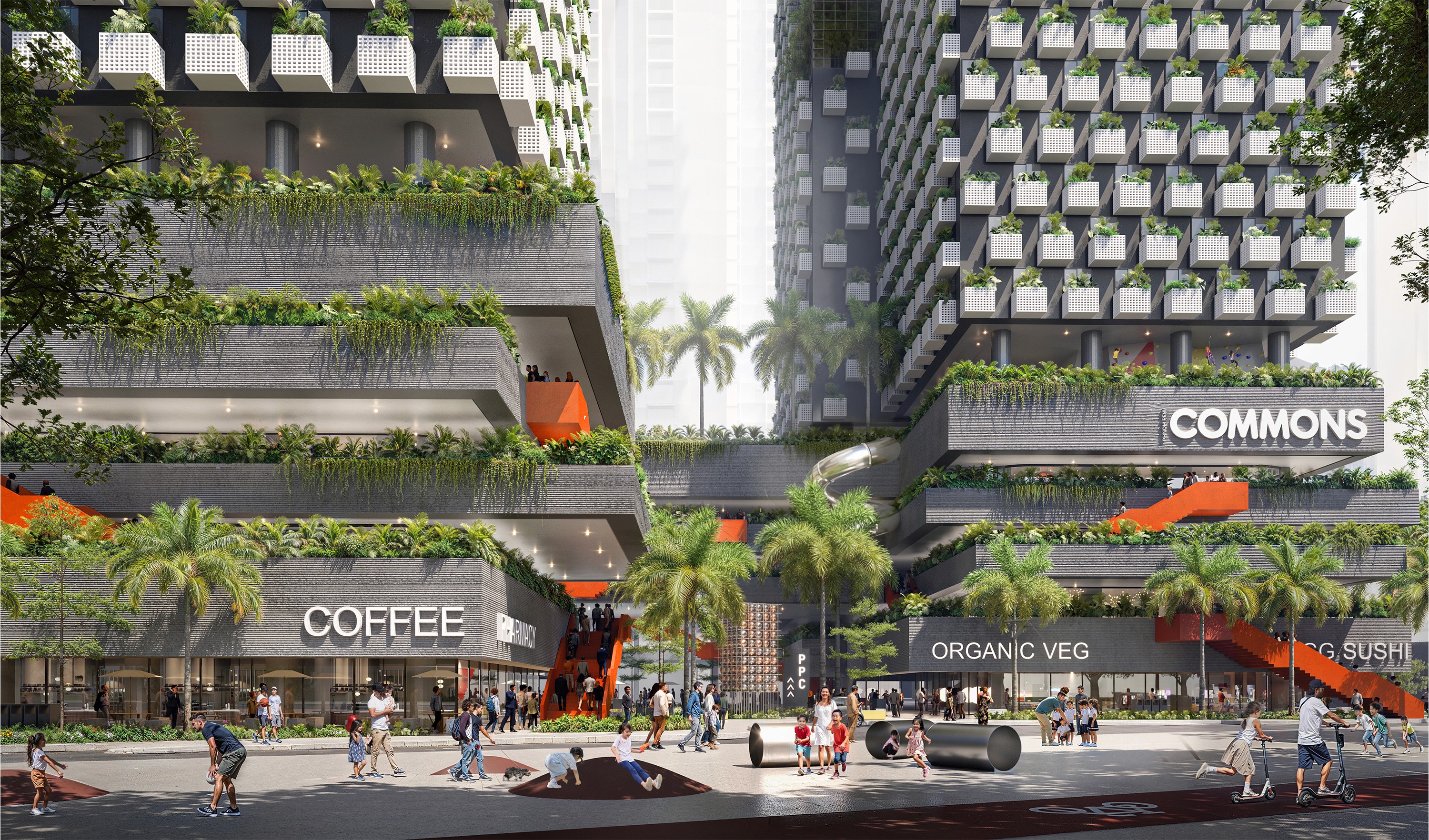
Phnom Penh Commons by The Room Architecture and Design.
Key takeaways
Real estate brand identity is more than a name, logo, or facade. It aligns a project's purpose, intended users, physical architecture, communication, and post-handover delivery.
Replicating standard layouts, finishes, and amenities forces developments to compete primarily on price per square meter, compressing margins in an increasingly competitive market.
Distinctive positioning relies on a disciplined process: matching location with typology in feasibility, designing for a specific niche, allocating capital to functional and durable details, and protecting developer credibility through delivery.
An asset's market identity is ultimately validated after completion through facility management, maintenance standards, and daily operational reliability.
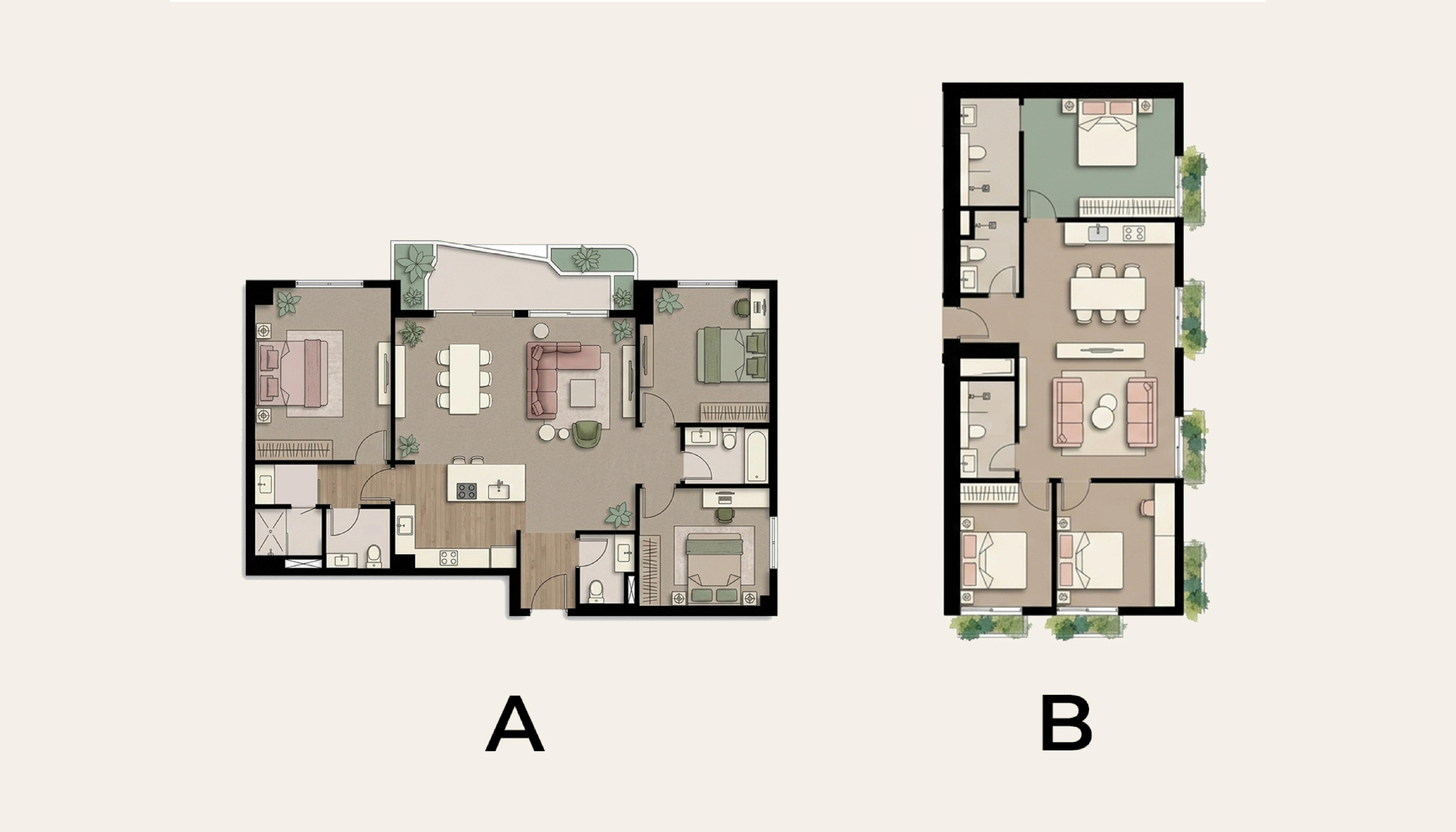
Two three-bedroom layouts show how similar planning and amenities can sit within very different market positions. Layouts generated by Gemini.
During a recent session hosted at our studio with CanCham's Urban Development Committee, we began by placing two floor plans side by side. Both represented three-bedroom residential units in Boeung Keng Kang 1. Both featured comparable floor areas, standard contemporary layouts, and familiar residential amenities. When examining asking prices on the market, the price difference between the two units was nearly threefold.
While numerous market variables influence listing figures, this exercise points to a broader pattern across Phnom Penh. A noticeable portion of current and pipeline developments offer similar floor plates, similar material specifications, and compete for overlapping buyer pools. When properties lack a clear differentiation strategy, price discounting often becomes the primary mechanism used to drive absorption.
Competing primarily on price tends to compress development margins and introduce long-term market vulnerability. Developing a distinctive real estate brand identity provides a more sustainable path to commercial viability.
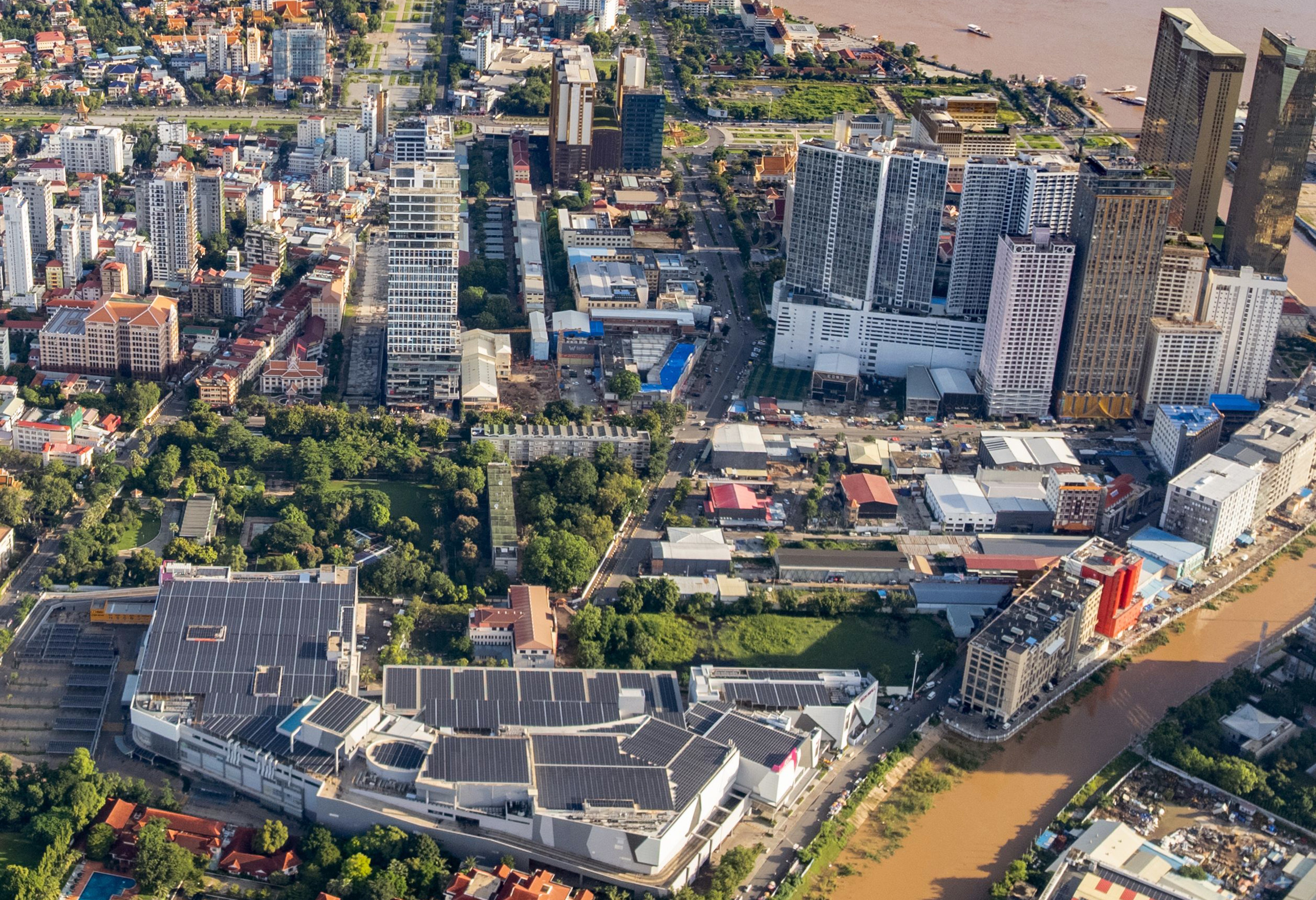
Phnom Penh’s urban landscape brings residential, commercial, and mixed-use developments into close proximity, creating a more competitive environment for real estate projects and the identities they establish. Photo by Nara Tsitra via Pexels.
Defining real estate brand identity: why, what, and how
Real estate brand identity in Cambodia is the strategic alignment of a project's operational purpose, target demographic, physical architecture, communication channels, and post-handover performance.
Rather than treating identity as a decorative layer applied late in the sales process through signage or naming, we evaluate it through three interconnected components:
1. The why: defining a clear reason to exist
Every development requires an operational rationale that matches its physical location and context. Introducing an asset type without assessing genuine local demand often leads to commercial friction. For example, placing an upscale steakhouse inside an everyday convenience mall creates an immediate mismatch. Most visitors do not go to a neighborhood mall looking for an expensive steak dinner. A clear operational purpose starts with identifying who is already in a given location and what they are there to do.
2. The what: building the right product for a defined niche
Projects often attempt to appeal to every market segment simultaneously, resulting in generic spaces that fail to build strong user loyalty. In regional markets, developers occasionally deliver multiple buildings featuring identical unit configurations, differentiated only by a modified exterior facade. A modified facade skin does not constitute a distinct product. More durable developments shape the spatial brief around specific user requirements, configuring circulation, unit layouts, and shared amenities to serve a clearly defined market niche.
3. The how: maintaining consistency across execution
Identity relies on maintaining discipline across every project touchpoint. Inconsistent messaging and disjointed planning dilute market recognition. For example, promoting a Chinese-backed residential project to a local buyer demographic in Khmer on LinkedIn, a platform that is primarily English-speaking, introduces immediate audience and channel friction. In contrast, developments like Odom maintain execution discipline by incorporating targeted amenities, such as a designated dog park and public green spaces that attract residents invested in outdoor activity and healthy lifestyles, paired with strata offices planned specifically for targeted business sectors.
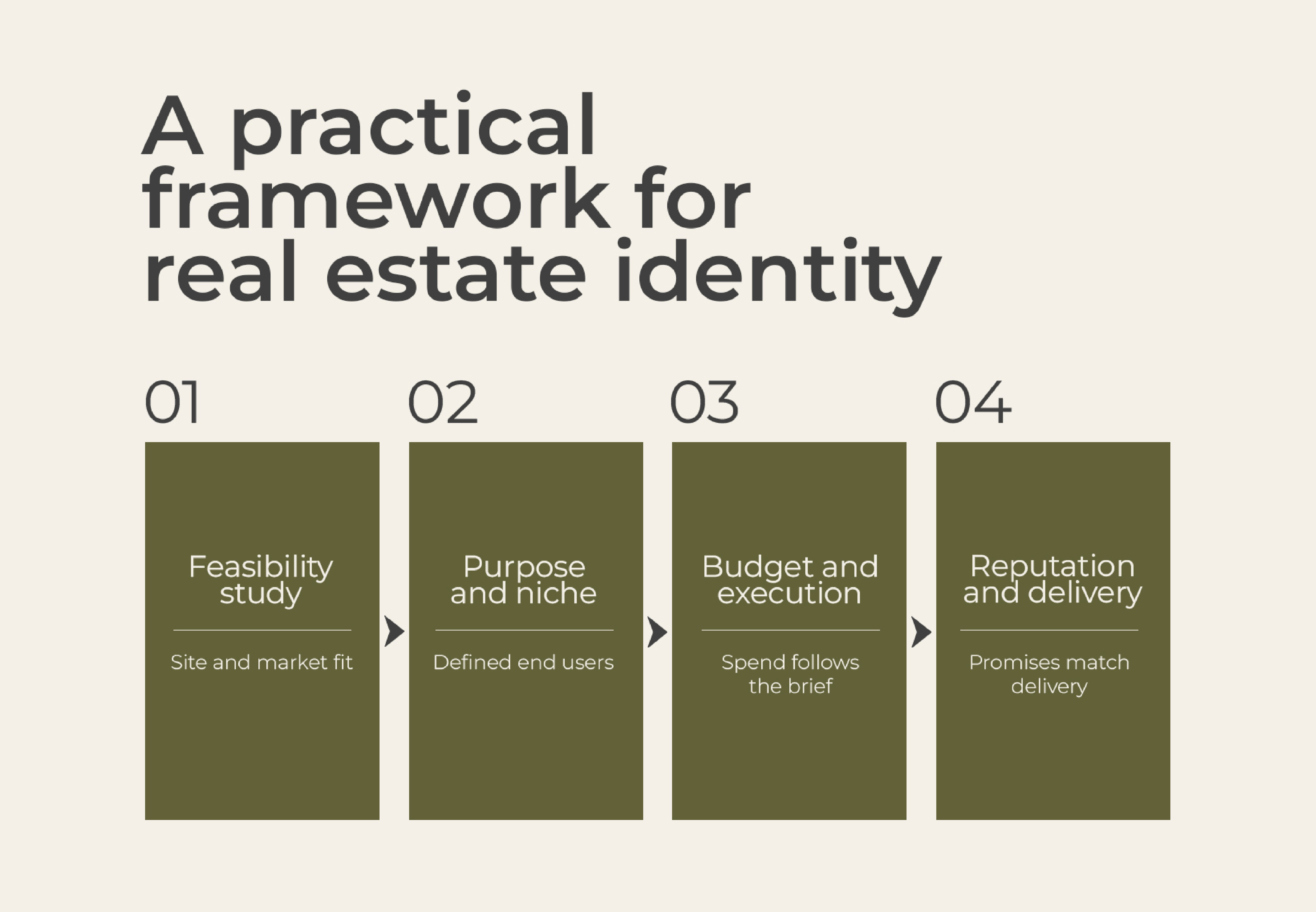
A structured four-stage development process for establishing and delivering a defensible real estate brand identity.
A practical framework for real estate identity
Translating brand identity into physical planning and commercial viability requires a structured development process across four primary stages:
1. Feasibility study
Location and typology must align from the outset. A development site cannot simply be forced into a predetermined residential or commercial template without objective analysis. Early feasibility evaluates whether a proposed building typology corresponds to surrounding transport infrastructure, local accessibility, and shifting market dynamics. Resolving these factors early between developer, commercial advisers, and architect helps clarify project viability before substantial capital is committed.
2. Purpose and niche
A development must establish who it is intended for and why those users will occupy it. Defining a clear purpose helps avoid generic floor plates, shaping physical spaces around genuine end-user requirements rather than replicating existing market templates.
3. Budget and execution
A fixed construction budget is often allocated the same way regardless of who the project is for: a standard finish package, a familiar amenity list, and contingency spread thinly across everything. This defaults the project back toward the market average it was meant to stand apart from. Budget discipline in service of identity means directing spend toward the elements the target buyer actually notices, even when that means visibly spending less on something a competing project down the road has prioritized.
4. Reputation and delivery
A project's brand identity is ultimately tested through post-completion performance, not through the marketing used to sell it. If a project is marketed around quiet, family-oriented living but the finished building places mechanical rooms or refuse collection points beside residential units, the gap between promise and delivery becomes apparent to residents within the first year. Consistently matching the finished asset to what was communicated during off-plan sales, unit by unit and amenity by amenity, is what builds developer credibility for the next project in the pipeline.
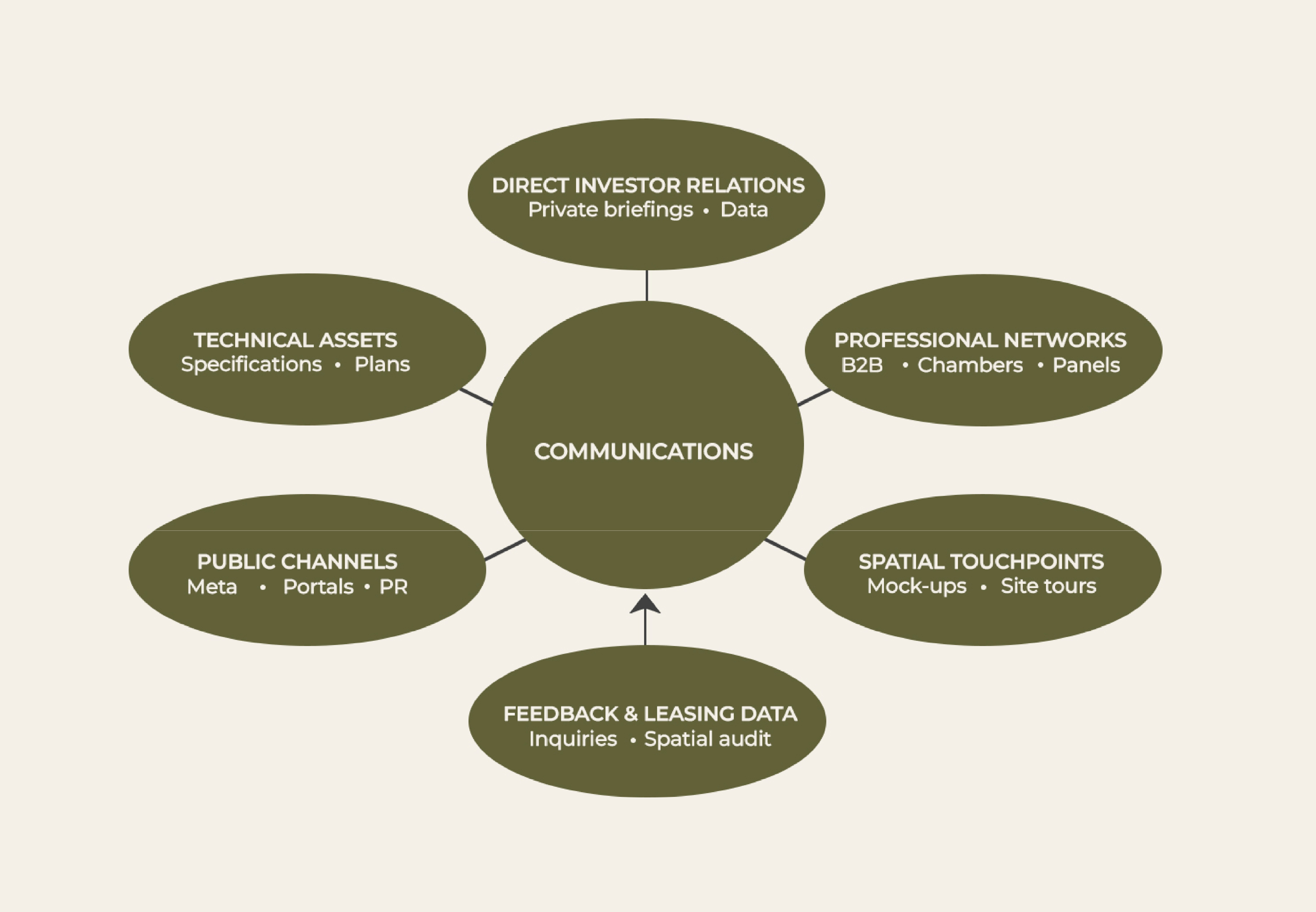
An integrated communication framework connecting institutional, professional, and public channels beyond standard social media advertising.
Communication: beyond social media channels
Property marketing in Southeast Asia frequently relies on a narrow approach: high-frequency advertising across Facebook and Instagram. While social platforms offer broad public reach, communicating real estate value requires a broader, more coordinated ecosystem:
Language and context: Structuring messaging around the actual language habits, professional contexts, and cultural preferences of the target market rather than relying on direct mechanical translations.
Channel alignment: Matching the medium to the intended audience, balancing public digital platforms for general visibility with direct investor relations and professional networks for commercial occupiers.
Message discipline: Communicating relevant technical standards, construction specifications, and operational logistics to commercial decision-makers, while presenting day-to-day usability to residential end users.
Continuous feedback: Tracking buyer inquiries and leasing questions to identify which spatial layouts and amenities generate authentic demand, using those observations to inform future project phases.
The complete asset: management, handover, and modern planning tools
A development's identity depends on more than architectural design and strategic marketing. It is proven by how the asset functions after practical completion.
If property management, maintenance workflows, and customer services do not correspond to what was communicated during the sales phase, market perception and long-term asset value can decline rapidly. Daily facility upkeep, operational reliability, and meeting initial commitments determine how the property performs over its lifecycle.
At the same time, analytical software and emerging spatial tools increasingly assist project teams in evaluating options early in the process. Generative planning tools, daylight simulations, and circulation modeling help developers and architects evaluate multiple layout scenarios, identify spatial bottlenecks, and verify structural efficiency before tender documentation is completed.
Real estate brand identity in Cambodia is not a cosmetic layer applied to an exterior facade. It is established through market research, resolved through architectural planning, and validated through construction quality, operational reliability, and ongoing facility management. In an increasingly competitive market, developments that define a clear purpose and deliver on it in practice will retain their commercial relevance over the long term.
Key takeaways
Real estate brand identity is more than a name, logo, or facade. It aligns a project's purpose, intended users, physical architecture, communication, and post-handover delivery.
Replicating standard layouts, finishes, and amenities forces developments to compete primarily on price per square meter, compressing margins in an increasingly competitive market.
Distinctive positioning relies on a disciplined process: matching location with typology in feasibility, designing for a specific niche, allocating capital to functional and durable details, and protecting developer credibility through delivery.
An asset's market identity is ultimately validated after completion through facility management, maintenance standards, and daily operational reliability.
Two three-bedroom layouts show how similar planning and amenities can sit within very different market positions. Layouts generated by Gemini.
During a recent session hosted at our studio with CanCham's Urban Development Committee, we began by placing two floor plans side by side. Both represented three-bedroom residential units in Boeung Keng Kang 1. Both featured comparable floor areas, standard contemporary layouts, and familiar residential amenities. When examining asking prices on the market, the price difference between the two units was nearly threefold.
While numerous market variables influence listing figures, this exercise points to a broader pattern across Phnom Penh. A noticeable portion of current and pipeline developments offer similar floor plates, similar material specifications, and compete for overlapping buyer pools. When properties lack a clear differentiation strategy, price discounting often becomes the primary mechanism used to drive absorption.
Competing primarily on price tends to compress development margins and introduce long-term market vulnerability. Developing a distinctive real estate brand identity provides a more sustainable path to commercial viability.
Phnom Penh’s urban landscape brings residential, commercial, and mixed-use developments into close proximity, creating a more competitive environment for real estate projects and the identities they establish. Photo by Nara Tsitra via Pexels.
Defining real estate brand identity: why, what, and how
Real estate brand identity in Cambodia is the strategic alignment of a project's operational purpose, target demographic, physical architecture, communication channels, and post-handover performance.
Rather than treating identity as a decorative layer applied late in the sales process through signage or naming, we evaluate it through three interconnected components:
1. The why: defining a clear reason to exist
Every development requires an operational rationale that matches its physical location and context. Introducing an asset type without assessing genuine local demand often leads to commercial friction. For example, placing an upscale steakhouse inside an everyday convenience mall creates an immediate mismatch. Most visitors do not go to a neighborhood mall looking for an expensive steak dinner. A clear operational purpose starts with identifying who is already in a given location and what they are there to do.
2. The what: building the right product for a defined niche
Projects often attempt to appeal to every market segment simultaneously, resulting in generic spaces that fail to build strong user loyalty. In regional markets, developers occasionally deliver multiple buildings featuring identical unit configurations, differentiated only by a modified exterior facade. A modified facade skin does not constitute a distinct product. More durable developments shape the spatial brief around specific user requirements, configuring circulation, unit layouts, and shared amenities to serve a clearly defined market niche.
3. The how: maintaining consistency across execution
Identity relies on maintaining discipline across every project touchpoint. Inconsistent messaging and disjointed planning dilute market recognition. For example, promoting a Chinese-backed residential project to a local buyer demographic in Khmer on LinkedIn, a platform that is primarily English-speaking, introduces immediate audience and channel friction. In contrast, developments like Odom maintain execution discipline by incorporating targeted amenities, such as a designated dog park and public green spaces that attract residents invested in outdoor activity and healthy lifestyles, paired with strata offices planned specifically for targeted business sectors.
A structured four-stage development process for establishing and delivering a defensible real estate brand identity.
A practical framework for real estate identity
Translating brand identity into physical planning and commercial viability requires a structured development process across four primary stages:
1. Feasibility study
Location and typology must align from the outset. A development site cannot simply be forced into a predetermined residential or commercial template without objective analysis. Early feasibility evaluates whether a proposed building typology corresponds to surrounding transport infrastructure, local accessibility, and shifting market dynamics. Resolving these factors early between developer, commercial advisers, and architect helps clarify project viability before substantial capital is committed.
2. Purpose and niche
A development must establish who it is intended for and why those users will occupy it. Defining a clear purpose helps avoid generic floor plates, shaping physical spaces around genuine end-user requirements rather than replicating existing market templates.
3. Budget and execution
A fixed construction budget is often allocated the same way regardless of who the project is for: a standard finish package, a familiar amenity list, and contingency spread thinly across everything. This defaults the project back toward the market average it was meant to stand apart from. Budget discipline in service of identity means directing spend toward the elements the target buyer actually notices, even when that means visibly spending less on something a competing project down the road has prioritized.
4. Reputation and delivery
A project's brand identity is ultimately tested through post-completion performance, not through the marketing used to sell it. If a project is marketed around quiet, family-oriented living but the finished building places mechanical rooms or refuse collection points beside residential units, the gap between promise and delivery becomes apparent to residents within the first year. Consistently matching the finished asset to what was communicated during off-plan sales, unit by unit and amenity by amenity, is what builds developer credibility for the next project in the pipeline.
An integrated communication framework connecting institutional, professional, and public channels beyond standard social media advertising.
Communication: beyond social media channels
Property marketing in Southeast Asia frequently relies on a narrow approach: high-frequency advertising across Facebook and Instagram. While social platforms offer broad public reach, communicating real estate value requires a broader, more coordinated ecosystem:
Language and context: Structuring messaging around the actual language habits, professional contexts, and cultural preferences of the target market rather than relying on direct mechanical translations.
Channel alignment: Matching the medium to the intended audience, balancing public digital platforms for general visibility with direct investor relations and professional networks for commercial occupiers.
Message discipline: Communicating relevant technical standards, construction specifications, and operational logistics to commercial decision-makers, while presenting day-to-day usability to residential end users.
Continuous feedback: Tracking buyer inquiries and leasing questions to identify which spatial layouts and amenities generate authentic demand, using those observations to inform future project phases.
The complete asset: management, handover, and modern planning tools
A development's identity depends on more than architectural design and strategic marketing. It is proven by how the asset functions after practical completion.
If property management, maintenance workflows, and customer services do not correspond to what was communicated during the sales phase, market perception and long-term asset value can decline rapidly. Daily facility upkeep, operational reliability, and meeting initial commitments determine how the property performs over its lifecycle.
At the same time, analytical software and emerging spatial tools increasingly assist project teams in evaluating options early in the process. Generative planning tools, daylight simulations, and circulation modeling help developers and architects evaluate multiple layout scenarios, identify spatial bottlenecks, and verify structural efficiency before tender documentation is completed.
Real estate brand identity in Cambodia is not a cosmetic layer applied to an exterior facade. It is established through market research, resolved through architectural planning, and validated through construction quality, operational reliability, and ongoing facility management. In an increasingly competitive market, developments that define a clear purpose and deliver on it in practice will retain their commercial relevance over the long term.
Key takeaways
Real estate brand identity is more than a name, logo, or facade. It aligns a project's purpose, intended users, physical architecture, communication, and post-handover delivery.
Replicating standard layouts, finishes, and amenities forces developments to compete primarily on price per square meter, compressing margins in an increasingly competitive market.
Distinctive positioning relies on a disciplined process: matching location with typology in feasibility, designing for a specific niche, allocating capital to functional and durable details, and protecting developer credibility through delivery.
An asset's market identity is ultimately validated after completion through facility management, maintenance standards, and daily operational reliability.
Two three-bedroom layouts show how similar planning and amenities can sit within very different market positions. Layouts generated by Gemini.
During a recent session hosted at our studio with CanCham's Urban Development Committee, we began by placing two floor plans side by side. Both represented three-bedroom residential units in Boeung Keng Kang 1. Both featured comparable floor areas, standard contemporary layouts, and familiar residential amenities. When examining asking prices on the market, the price difference between the two units was nearly threefold.
While numerous market variables influence listing figures, this exercise points to a broader pattern across Phnom Penh. A noticeable portion of current and pipeline developments offer similar floor plates, similar material specifications, and compete for overlapping buyer pools. When properties lack a clear differentiation strategy, price discounting often becomes the primary mechanism used to drive absorption.
Competing primarily on price tends to compress development margins and introduce long-term market vulnerability. Developing a distinctive real estate brand identity provides a more sustainable path to commercial viability.
Phnom Penh’s urban landscape brings residential, commercial, and mixed-use developments into close proximity, creating a more competitive environment for real estate projects and the identities they establish. Photo by Nara Tsitra via Pexels.
Defining real estate brand identity: why, what, and how
Real estate brand identity in Cambodia is the strategic alignment of a project's operational purpose, target demographic, physical architecture, communication channels, and post-handover performance.
Rather than treating identity as a decorative layer applied late in the sales process through signage or naming, we evaluate it through three interconnected components:
1. The why: defining a clear reason to exist
Every development requires an operational rationale that matches its physical location and context. Introducing an asset type without assessing genuine local demand often leads to commercial friction. For example, placing an upscale steakhouse inside an everyday convenience mall creates an immediate mismatch. Most visitors do not go to a neighborhood mall looking for an expensive steak dinner. A clear operational purpose starts with identifying who is already in a given location and what they are there to do.
2. The what: building the right product for a defined niche
Projects often attempt to appeal to every market segment simultaneously, resulting in generic spaces that fail to build strong user loyalty. In regional markets, developers occasionally deliver multiple buildings featuring identical unit configurations, differentiated only by a modified exterior facade. A modified facade skin does not constitute a distinct product. More durable developments shape the spatial brief around specific user requirements, configuring circulation, unit layouts, and shared amenities to serve a clearly defined market niche.
3. The how: maintaining consistency across execution
Identity relies on maintaining discipline across every project touchpoint. Inconsistent messaging and disjointed planning dilute market recognition. For example, promoting a Chinese-backed residential project to a local buyer demographic in Khmer on LinkedIn, a platform that is primarily English-speaking, introduces immediate audience and channel friction. In contrast, developments like Odom maintain execution discipline by incorporating targeted amenities, such as a designated dog park and public green spaces that attract residents invested in outdoor activity and healthy lifestyles, paired with strata offices planned specifically for targeted business sectors.
A structured four-stage development process for establishing and delivering a defensible real estate brand identity.
A practical framework for real estate identity
Translating brand identity into physical planning and commercial viability requires a structured development process across four primary stages:
1. Feasibility study
Location and typology must align from the outset. A development site cannot simply be forced into a predetermined residential or commercial template without objective analysis. Early feasibility evaluates whether a proposed building typology corresponds to surrounding transport infrastructure, local accessibility, and shifting market dynamics. Resolving these factors early between developer, commercial advisers, and architect helps clarify project viability before substantial capital is committed.
2. Purpose and niche
A development must establish who it is intended for and why those users will occupy it. Defining a clear purpose helps avoid generic floor plates, shaping physical spaces around genuine end-user requirements rather than replicating existing market templates.
3. Budget and execution
A fixed construction budget is often allocated the same way regardless of who the project is for: a standard finish package, a familiar amenity list, and contingency spread thinly across everything. This defaults the project back toward the market average it was meant to stand apart from. Budget discipline in service of identity means directing spend toward the elements the target buyer actually notices, even when that means visibly spending less on something a competing project down the road has prioritized.
4. Reputation and delivery
A project's brand identity is ultimately tested through post-completion performance, not through the marketing used to sell it. If a project is marketed around quiet, family-oriented living but the finished building places mechanical rooms or refuse collection points beside residential units, the gap between promise and delivery becomes apparent to residents within the first year. Consistently matching the finished asset to what was communicated during off-plan sales, unit by unit and amenity by amenity, is what builds developer credibility for the next project in the pipeline.
An integrated communication framework connecting institutional, professional, and public channels beyond standard social media advertising.
Communication: beyond social media channels
Property marketing in Southeast Asia frequently relies on a narrow approach: high-frequency advertising across Facebook and Instagram. While social platforms offer broad public reach, communicating real estate value requires a broader, more coordinated ecosystem:
Language and context: Structuring messaging around the actual language habits, professional contexts, and cultural preferences of the target market rather than relying on direct mechanical translations.
Channel alignment: Matching the medium to the intended audience, balancing public digital platforms for general visibility with direct investor relations and professional networks for commercial occupiers.
Message discipline: Communicating relevant technical standards, construction specifications, and operational logistics to commercial decision-makers, while presenting day-to-day usability to residential end users.
Continuous feedback: Tracking buyer inquiries and leasing questions to identify which spatial layouts and amenities generate authentic demand, using those observations to inform future project phases.
The complete asset: management, handover, and modern planning tools
A development's identity depends on more than architectural design and strategic marketing. It is proven by how the asset functions after practical completion.
If property management, maintenance workflows, and customer services do not correspond to what was communicated during the sales phase, market perception and long-term asset value can decline rapidly. Daily facility upkeep, operational reliability, and meeting initial commitments determine how the property performs over its lifecycle.
At the same time, analytical software and emerging spatial tools increasingly assist project teams in evaluating options early in the process. Generative planning tools, daylight simulations, and circulation modeling help developers and architects evaluate multiple layout scenarios, identify spatial bottlenecks, and verify structural efficiency before tender documentation is completed.
Real estate brand identity in Cambodia is not a cosmetic layer applied to an exterior facade. It is established through market research, resolved through architectural planning, and validated through construction quality, operational reliability, and ongoing facility management. In an increasingly competitive market, developments that define a clear purpose and deliver on it in practice will retain their commercial relevance over the long term.